I just finished reading Lit by Mary Karr, a memoir about her adult life, past The Liar's Club, her first memoir and one that helped kick off the current memoir genre popularity. That memoir was about her terrifying childhood and difficult mother. This one is about her college, marriage, alcoholism, recovery and discovery of faith - as well as a relationship to her mother, which is the undercurrent of the book.
It's a tall order, now that I think about it. Finishing it I realize it spans about twenty years, if not more. The uniqueness in this, I suppose, reading her other book, is that this book - while still having certainly enough drama in it - is about the legacy of the pain. It's clear she had to deal with it while writing about it, but is honest enough to not pretend as if that makes everything okay. She still has to live with who she is. The way she does that, or figures out how to do that, is the meat of the book. She's eloquent and simple when walking through her recovery, even her conversion. The writing on sobriety is great, and you see why she's walking the road she's on, even though at times it's not at all a comfort.
It's a big book. I definitely felt her poetry in her writing, sometimes to its detriment, but not for most of it. Only a couple of times did I feel like her Writing was getting in the way of her writing - by that I mean her crafting of words was so enjoyable to her that I lost what was being said. It can be a danger - I didn't finish Rick Bragg's "All over but the shouting" because of it - but that's my own pet peeve. I'm sure some people love it. Mostly, though, her poetic language serves her well - to clarify who she is and to specify her feeling - her poetic language makes her feelings more specific, which is the whole point.
If I could give you plot points I would probably have a more eloquent review here, but I'm loath to do that. The beauty of this book is in the journey, and it's a hard-earned beautiful journey. Her gift is in telling her story so well - with enough self-knowledge to keep her searching for more, but not an over-abundance that keeps her at a remove. She's super-smart, that's clear, and funny. But she isn't living as an analyst by any means.
I was also struck how much she respects the people in her book. It's clear she's very respectful of her ex-husband and her part in their relationship; she resists the temptation to demonize him. Or anyone. That may be the key feature in her recovery that is so apparent - her compassion. She resists demonizing almost anyone, and everyone comes across as wonderfully human. That's an accomplishment, and certainly for a memoirist who controls how we see everyone. I most admire the end of the book. There's a moment when it could be easily warmly wrapped up - almost a Hollywood ending. Life's not that simple, though. I'm sure she could have ended it that way without bending any truth, but by not doing that the ending felt earned, which I think is much harder to achieve.
I won't give away anything, I would just say read it. It's a broad book about a specific life, and that's a beautiful thing.
Wednesday, July 07, 2010


Monday, June 28, 2010
Movie Capsules from the weekend
I saw a few movies this weekend. It’s been a while, actually, since I’ve seen this many in a short amount of time. I had sinus surgery, and needed to get out of the house. Movies are great in that they really only require you to move from sitting one place to sitting another. A friend had tickets for a musical, and I knew I wasn’t up for that, but a few movies, that I could do.

Toy Story 3. It made me cry, and then I couldn’t blow my nose becuase of the sinus surgery - darn you, Pixar! That’s some kind of torture. They just hit this one out of the park. It’s definitely action/adventure caper that you’d expect from a sequel, but underneath is an exploration of childhood, friendship, purpose, and saying goodbye. I really was blindsided, even though I was warned, at how affecting it was. The voice talent and animation are top notch, and it manages to be clever and inventive without ever feeling like it’s reaching for a joke. I can’t remember the last narrative live action film I was this moved by. That’s saying something.

Joan Rivers: A Piece of Work. Go. See. This. Film. She’s certainly complicated, and the glimpse I took of the reviews indicate that one’s reception of the film will be colored by one’s opinion of her. I doubt, though, that you will be able to come away from this movie without a healthy dose of respect for her. She does define the term “workaholic”, but you leave the film uncertain if that’s a bad thing. Depending on your view, she might be a tragic figure, unable to enjoy the fruits of her outsize labor; a survivor who has not let a lifetime of pain stop her from her dreams; a unquenchable personification of ambition that ultimately has no satisfaction – a kind of Tantalus. I left with a great respect for her work, her no-holds barred self-assessment, and her big heart. I don’t know if she’s hiding an inner depth, or some deep pain that she’s not in touch with – there is exploration of her husband’s suicide and their relationship as well as with her daughter, but nothing of her formative years that sound like they may have been painful (when a heckler tells her he has a deaf child and she’s not funny, she responds that her mother was deaf and we have to laugh at life to deal with the pain). At several points, you see how she has struggled, and her belief that live is above all hard – after delivering a Thanksgiving meal to a woman in a wheelchair with MS who had been an art photographer she bluntly says, “Life is so…mean!” No matter, though – she doesn’t dwell on it for very long, and doesn’t present herself as a nut to crack. She’s fascinating, though, and funny, funny, funny. I think the filmmakers have taken a little heat for this being too sympathetic, but it doesn't feel puffy to me at all. If there's anything you can say about her, it's that she's certainly ruthless in her own self - assessment. After playing a tribute at the Kennedy Center she is asked how she thought she did and she says "Funnier than some, not as funny as others" and then it's on to the next gig.

Io Sono L'Amore (I Am Love). I will right away say this is not a film for everyone. On some level it feels like a showcase for Tilda Swinton, but what a showcase it is. It’s reminiscent of Sirk, Visconti, heavily visual, even sensual. In fact, it’s probably the closest you’d get to a completely sensual film without reaching out and touching anything. Tilda Swinton plays a Russian woman who has married into a wealthy Italian family, has three children about college age or after, and is having an awakening. I’ll leave it at that. I will say, though, that the scenery (both natural and man-made) is luxurious, luscious and swoon-inducing, as is Edoardo Gabbriellini (managing to be not ridiculously perfect but perfectly what he needs to be), who is part of her awakening. The interiors of the house, the clothes, and then the countryside around Sanremo are just voluptuous. Heavily visual, it nevertheless packs a wallop story wise, and was unexpectedly moving. Swinton is just so fascinating. Her face is mask-like, in that it never seems to betray great emotion, yet is full of it. She’s completely in control of her faculties. It’s a joy to see someone at the top of their game, and even more in a role that’s so delicate. She’s a walled-off character, somewhat reticent, and her bloom reflects that as well. She can be unbelievably ravishing or plain, blend into walls or make you forget there's anyone else in the room. She never is seeming to work hard - it's all effortless. There’s also an amazing, amazing scene with Maria Paiato, who plays her maid, which is almost shocking in how affecting it is. These are my favorite moments in films - when some emotion has been quietly building that you don’t even know is there, and it reveals itself in full force. An incredible supporting cast in this, too. Marisa Berenson turns it out as the family matriarch. Note perfect. A scene when the women close ranks against a beau who has been rejected tells you everything you would need to know about the super-rich, or the super-rich in this world. I love the formalism - how it's just so film-y, for want of a better word, using the medium as an illustrative, impressionistic, emotional tool. I gasped at one point.
Well, I guess between that and Toy Story, it was quite an emotional weekend.

Let the Right One In – Okay, so this is a couple years old. Norwegian film about an unhappy 12 year old boy and the girl vampire that moves in next door. I had heard great things about it and wasn’t disappointed. It’s definitely not an American movie – it takes its time to set up both the suspense and the relationship between the two kids. The violence is disturbing and gruesome, which is kind of a nice change from the current trend of sexy vampires everywhere (that sounds like a movie itself). There is some humor, hapless adults, the true unhappiness and loneliness that can beset a kid of that age – especially an unpopular, bullied kid. Their relationship is wonderful, and allowed to develop at a pace that makes sense while the world is circling closer and closer to her secret. Lina Leandersson plays Eli, the 12 year old vampire with a centuries old soul, and is - I don’t even have the superlatives. Suffice it to say she’s brilliant, and I was floored at her pulling it off. It’s a great story, and both she and the boy were great, but she just blew me away. I was surprised how much I liked it. Kind of a haunting film. I hope they don’t do a crappy American remake. Fingers crossed. I love American movies, but a lot of times they remake a great European movie and miss the point. People should just rent this one. I mean, it won 60 International film awards, so it’s gotta be good, right?
I would highly recommend all four films. That's a great average - been a while since I could say that.

Toy Story 3. It made me cry, and then I couldn’t blow my nose becuase of the sinus surgery - darn you, Pixar! That’s some kind of torture. They just hit this one out of the park. It’s definitely action/adventure caper that you’d expect from a sequel, but underneath is an exploration of childhood, friendship, purpose, and saying goodbye. I really was blindsided, even though I was warned, at how affecting it was. The voice talent and animation are top notch, and it manages to be clever and inventive without ever feeling like it’s reaching for a joke. I can’t remember the last narrative live action film I was this moved by. That’s saying something.

Joan Rivers: A Piece of Work. Go. See. This. Film. She’s certainly complicated, and the glimpse I took of the reviews indicate that one’s reception of the film will be colored by one’s opinion of her. I doubt, though, that you will be able to come away from this movie without a healthy dose of respect for her. She does define the term “workaholic”, but you leave the film uncertain if that’s a bad thing. Depending on your view, she might be a tragic figure, unable to enjoy the fruits of her outsize labor; a survivor who has not let a lifetime of pain stop her from her dreams; a unquenchable personification of ambition that ultimately has no satisfaction – a kind of Tantalus. I left with a great respect for her work, her no-holds barred self-assessment, and her big heart. I don’t know if she’s hiding an inner depth, or some deep pain that she’s not in touch with – there is exploration of her husband’s suicide and their relationship as well as with her daughter, but nothing of her formative years that sound like they may have been painful (when a heckler tells her he has a deaf child and she’s not funny, she responds that her mother was deaf and we have to laugh at life to deal with the pain). At several points, you see how she has struggled, and her belief that live is above all hard – after delivering a Thanksgiving meal to a woman in a wheelchair with MS who had been an art photographer she bluntly says, “Life is so…mean!” No matter, though – she doesn’t dwell on it for very long, and doesn’t present herself as a nut to crack. She’s fascinating, though, and funny, funny, funny. I think the filmmakers have taken a little heat for this being too sympathetic, but it doesn't feel puffy to me at all. If there's anything you can say about her, it's that she's certainly ruthless in her own self - assessment. After playing a tribute at the Kennedy Center she is asked how she thought she did and she says "Funnier than some, not as funny as others" and then it's on to the next gig.

Io Sono L'Amore (I Am Love). I will right away say this is not a film for everyone. On some level it feels like a showcase for Tilda Swinton, but what a showcase it is. It’s reminiscent of Sirk, Visconti, heavily visual, even sensual. In fact, it’s probably the closest you’d get to a completely sensual film without reaching out and touching anything. Tilda Swinton plays a Russian woman who has married into a wealthy Italian family, has three children about college age or after, and is having an awakening. I’ll leave it at that. I will say, though, that the scenery (both natural and man-made) is luxurious, luscious and swoon-inducing, as is Edoardo Gabbriellini (managing to be not ridiculously perfect but perfectly what he needs to be), who is part of her awakening. The interiors of the house, the clothes, and then the countryside around Sanremo are just voluptuous. Heavily visual, it nevertheless packs a wallop story wise, and was unexpectedly moving. Swinton is just so fascinating. Her face is mask-like, in that it never seems to betray great emotion, yet is full of it. She’s completely in control of her faculties. It’s a joy to see someone at the top of their game, and even more in a role that’s so delicate. She’s a walled-off character, somewhat reticent, and her bloom reflects that as well. She can be unbelievably ravishing or plain, blend into walls or make you forget there's anyone else in the room. She never is seeming to work hard - it's all effortless. There’s also an amazing, amazing scene with Maria Paiato, who plays her maid, which is almost shocking in how affecting it is. These are my favorite moments in films - when some emotion has been quietly building that you don’t even know is there, and it reveals itself in full force. An incredible supporting cast in this, too. Marisa Berenson turns it out as the family matriarch. Note perfect. A scene when the women close ranks against a beau who has been rejected tells you everything you would need to know about the super-rich, or the super-rich in this world. I love the formalism - how it's just so film-y, for want of a better word, using the medium as an illustrative, impressionistic, emotional tool. I gasped at one point.
Well, I guess between that and Toy Story, it was quite an emotional weekend.

Let the Right One In – Okay, so this is a couple years old. Norwegian film about an unhappy 12 year old boy and the girl vampire that moves in next door. I had heard great things about it and wasn’t disappointed. It’s definitely not an American movie – it takes its time to set up both the suspense and the relationship between the two kids. The violence is disturbing and gruesome, which is kind of a nice change from the current trend of sexy vampires everywhere (that sounds like a movie itself). There is some humor, hapless adults, the true unhappiness and loneliness that can beset a kid of that age – especially an unpopular, bullied kid. Their relationship is wonderful, and allowed to develop at a pace that makes sense while the world is circling closer and closer to her secret. Lina Leandersson plays Eli, the 12 year old vampire with a centuries old soul, and is - I don’t even have the superlatives. Suffice it to say she’s brilliant, and I was floored at her pulling it off. It’s a great story, and both she and the boy were great, but she just blew me away. I was surprised how much I liked it. Kind of a haunting film. I hope they don’t do a crappy American remake. Fingers crossed. I love American movies, but a lot of times they remake a great European movie and miss the point. People should just rent this one. I mean, it won 60 International film awards, so it’s gotta be good, right?
I would highly recommend all four films. That's a great average - been a while since I could say that.
Monday, June 21, 2010
Perfect Endings
I had my heart broken a few times this weekend. I was listening to short stories again.
At the suggestion of a friend, I listened to couple from the New Yorker podcast, Richard Ford reading John Cheever’s “Reunion”, and A.M. Homes reading Shirley Jackson’s “The Lottery.” I hadn’t heard either, surprising I guess from the sound of the podcast, as it sounds like it’s taught in schools.
The Cheever is gorgeous, short, sharp, like a razor - you’re unaware of the damage until it’s already cut. It moves so quickly, and ends abruptly. That ending is what makes it for me. Not only is it a brilliant moment in a relationship between father and son, but it gives nothing away but starts the moment they start relating, and ends the moment they stop. It’s enough, though, to leave you with a heartache for the father and son. Ford said he wrote a story inspired by it, and reads his classes his story along side Cheevers –brave. It sounds like a great exercise – not just the inspiration, but to have an assignment to write a relationship like that – a scene that stands by itself as a full story. I tend to like those – compact, succinct, with enough room for my imagination. Ford said he goes back to it again and again, and I can see why. You almost want more, more juice, more to explain, but there’s no need. It’s a great balancing act. Heartbreaking.
Shirley Jackson’s “The Lottery” I didn’t know, though I had been warned from the pre-ample that something was going to happen. I started to guess about half way through, but thought it couldn’t possibly be what I thought it was. Interestingly, when it was published in 1946? 8? hundreds cancelled their subscription, horrified by the story. It’s intense, with almost no indication of what’s going to happen, but it circles closer and closer inevitably as the story moves along. It’s tight as a rock. The language is so simple, and once again, it ends almost shockingly abruptly. This and the Cheever are so brilliant in their resistance to tie things up, but leave you speeding up – almost as if they have pushed you up a ramp they’ve created, and the ramp ends with you in mid-air and nothing to catch. Both are quite exhilarating. It’s interesting that Homes and Deborah Triesman, the fiction editor of the New Yorker, talk about how she’s fallen by the wayside. Holmes suggests it’s because there are no women writers from mid-century that are read now. I was in my car thinking “Flannery O’Connor, Eudora Welty, Katherine Anne Porter”. They didn’t hear me.
A few other highlights as well – I’m probably sounding like a broken record using “beautiful” and “gorgeous” to describe these, but I did love and think was beautiful Lorrie Moore’s story “Dance in America” that Louis Erdrich read on the New Yorker podcast. I can’t even go into how subtly heartbreaking this is, but to do this kind of thing in a short story is like amazing song writing. You listen over and over and can’t figure out how something so short can be so packed. It was so full in fact, I found myself making up alternate stories in my head out of the small details just thrown about. A woman meets up with a man she hasn’t seen since college while teaching a group of elementary students dance in the town. He lives with his French wife and his son with cystic fibrosis in an abandoned frat house. This one manages to break your heart and salve it at the same time. How is that possible?
I guess I listened to a lot – there’s a beautiful story read on Selected Shorts called “Wild Plums” by Grace Stone Coates that John Updike selected for the best short stories of the century. Looks like he also selected a Jean Stafford story, and I’d love to read more of her. Wild Plums, though - once again magical, simple, surprising – was written in 1929. I was overwhelmed with the desire for this Kansas farm girl to eat a wild plum and break out of the stern control of her parents. Once again, the perfect ending.
How do they do it?
At the suggestion of a friend, I listened to couple from the New Yorker podcast, Richard Ford reading John Cheever’s “Reunion”, and A.M. Homes reading Shirley Jackson’s “The Lottery.” I hadn’t heard either, surprising I guess from the sound of the podcast, as it sounds like it’s taught in schools.
The Cheever is gorgeous, short, sharp, like a razor - you’re unaware of the damage until it’s already cut. It moves so quickly, and ends abruptly. That ending is what makes it for me. Not only is it a brilliant moment in a relationship between father and son, but it gives nothing away but starts the moment they start relating, and ends the moment they stop. It’s enough, though, to leave you with a heartache for the father and son. Ford said he wrote a story inspired by it, and reads his classes his story along side Cheevers –brave. It sounds like a great exercise – not just the inspiration, but to have an assignment to write a relationship like that – a scene that stands by itself as a full story. I tend to like those – compact, succinct, with enough room for my imagination. Ford said he goes back to it again and again, and I can see why. You almost want more, more juice, more to explain, but there’s no need. It’s a great balancing act. Heartbreaking.
Shirley Jackson’s “The Lottery” I didn’t know, though I had been warned from the pre-ample that something was going to happen. I started to guess about half way through, but thought it couldn’t possibly be what I thought it was. Interestingly, when it was published in 1946? 8? hundreds cancelled their subscription, horrified by the story. It’s intense, with almost no indication of what’s going to happen, but it circles closer and closer inevitably as the story moves along. It’s tight as a rock. The language is so simple, and once again, it ends almost shockingly abruptly. This and the Cheever are so brilliant in their resistance to tie things up, but leave you speeding up – almost as if they have pushed you up a ramp they’ve created, and the ramp ends with you in mid-air and nothing to catch. Both are quite exhilarating. It’s interesting that Homes and Deborah Triesman, the fiction editor of the New Yorker, talk about how she’s fallen by the wayside. Holmes suggests it’s because there are no women writers from mid-century that are read now. I was in my car thinking “Flannery O’Connor, Eudora Welty, Katherine Anne Porter”. They didn’t hear me.
A few other highlights as well – I’m probably sounding like a broken record using “beautiful” and “gorgeous” to describe these, but I did love and think was beautiful Lorrie Moore’s story “Dance in America” that Louis Erdrich read on the New Yorker podcast. I can’t even go into how subtly heartbreaking this is, but to do this kind of thing in a short story is like amazing song writing. You listen over and over and can’t figure out how something so short can be so packed. It was so full in fact, I found myself making up alternate stories in my head out of the small details just thrown about. A woman meets up with a man she hasn’t seen since college while teaching a group of elementary students dance in the town. He lives with his French wife and his son with cystic fibrosis in an abandoned frat house. This one manages to break your heart and salve it at the same time. How is that possible?
I guess I listened to a lot – there’s a beautiful story read on Selected Shorts called “Wild Plums” by Grace Stone Coates that John Updike selected for the best short stories of the century. Looks like he also selected a Jean Stafford story, and I’d love to read more of her. Wild Plums, though - once again magical, simple, surprising – was written in 1929. I was overwhelmed with the desire for this Kansas farm girl to eat a wild plum and break out of the stern control of her parents. Once again, the perfect ending.
How do they do it?
Thursday, June 17, 2010
42
I’m 42 today.
I would usually start off the year with an intention; or perhaps an intention to have an intention but end up with a bad feeling about not having an intention.
But not this year.
This year, I’m just enjoying it. And although my other shoe-dropping mentality made “you’re going to die in your sleep” pop into my head right as I was setting my alarm last night, once again it was wrong. I did wake up. And at 7:17 EST, I turned 42, so I’m in the third year of my 5th decade.
So I had coffee with friends, lunch with work friends, and now dinner made by an old friend to spend with friends. How lucky is that?
I feel very grateful and gifted. Perhaps it’s the glow from my first acting award nomination. It’s certainly not that I’m behind 19 chapters on War & Peace to keep on my 365 day schedule (skipping a few days can really get you). I have a feeling about Andrei and Natasha – it’s all very exciting at the moment, but you know Napoleon and Waterloo are just around the corner. But I have sinus surgery next week, so that will keep me low enough to catch up on some chapters.
And maybe catch Tilda Swinton in “I Am Love”. This weekend’s a trip to Arizona to see family, so much podcasting – catching up on Short Stories, History, and Science. I love that.
There will be more to write about. My intention is manifesting itself just by being and see what’s next at the moment. And that’s a lovely place to be.
I would usually start off the year with an intention; or perhaps an intention to have an intention but end up with a bad feeling about not having an intention.
But not this year.
This year, I’m just enjoying it. And although my other shoe-dropping mentality made “you’re going to die in your sleep” pop into my head right as I was setting my alarm last night, once again it was wrong. I did wake up. And at 7:17 EST, I turned 42, so I’m in the third year of my 5th decade.
So I had coffee with friends, lunch with work friends, and now dinner made by an old friend to spend with friends. How lucky is that?
I feel very grateful and gifted. Perhaps it’s the glow from my first acting award nomination. It’s certainly not that I’m behind 19 chapters on War & Peace to keep on my 365 day schedule (skipping a few days can really get you). I have a feeling about Andrei and Natasha – it’s all very exciting at the moment, but you know Napoleon and Waterloo are just around the corner. But I have sinus surgery next week, so that will keep me low enough to catch up on some chapters.
And maybe catch Tilda Swinton in “I Am Love”. This weekend’s a trip to Arizona to see family, so much podcasting – catching up on Short Stories, History, and Science. I love that.
There will be more to write about. My intention is manifesting itself just by being and see what’s next at the moment. And that’s a lovely place to be.
Thursday, June 03, 2010
Short Stories
My friend Ted posted a question on his blog bookey-wookey if people preferred short fiction or novels. It's an interesting question.
I have a wierd relationship to them. I love Chekhov's short stories, but I do not choose to read stories as a genre. In the New Yorker I almost never do, unless it's Sherman Alexie or some writer I love who I just can't skip (he's another short form person I admire and find very readable). For the most part, though, I'm impatient with them. I'm kind of impatient with fiction lately anyway - maybe it's a function of aging - but some writers can still catch my eye. I haven't given up totally. Like everything, I'm sure it's cyclical. And, like everything, if it's an amazing short story, I love it. Joyce's Dubliners, Sherman Alexie's collections, Rachel Ingalls' novellas, Grace Paley - great writers. And I love essays, too, so it's not the shortness. Maybe it's just a hard form.
Then, I discovered the Selected Shorts podcast, and discovered I love short stories being read to me. That was revelatory. There's something wonderful about being told the whole story in voice, whereas books on tape leave me completely cold.
In fact, Joanna Gleason reading St. Lucy's Home for Girls Raised by Wolves is thrilling. That story I still remember - visceral, beautiful. I thought it would be a gimmick, and then it's unexpectedly about assimilation, adolescence, and pain. Stunning.
Another one that recently blew me away is on the New Yorker fiction podcast, where authors pick other authors' stories to read. Hilton Als read Jean Stafford's Children are Bored on Sunday, about an alcoholic woman's first foray after a breakdown to the Metropolitan Museum of Art. I actually wrote about these a little in my podcast entry when I started them. The stories are beautiful, so I guess that's my answer - I really love short fiction when it's being read to me.
Of course, I'm currently in RadioLab hole, and can't stop listening to the last 5 years of podcasts. I just listened to amazing stories about spindle cells, anthropomorhization, and animal brains on my way to work this morning. So all my friends are hearing about space, science, and brains. Which is a good story, too....
I have a wierd relationship to them. I love Chekhov's short stories, but I do not choose to read stories as a genre. In the New Yorker I almost never do, unless it's Sherman Alexie or some writer I love who I just can't skip (he's another short form person I admire and find very readable). For the most part, though, I'm impatient with them. I'm kind of impatient with fiction lately anyway - maybe it's a function of aging - but some writers can still catch my eye. I haven't given up totally. Like everything, I'm sure it's cyclical. And, like everything, if it's an amazing short story, I love it. Joyce's Dubliners, Sherman Alexie's collections, Rachel Ingalls' novellas, Grace Paley - great writers. And I love essays, too, so it's not the shortness. Maybe it's just a hard form.
Then, I discovered the Selected Shorts podcast, and discovered I love short stories being read to me. That was revelatory. There's something wonderful about being told the whole story in voice, whereas books on tape leave me completely cold.
In fact, Joanna Gleason reading St. Lucy's Home for Girls Raised by Wolves is thrilling. That story I still remember - visceral, beautiful. I thought it would be a gimmick, and then it's unexpectedly about assimilation, adolescence, and pain. Stunning.
Another one that recently blew me away is on the New Yorker fiction podcast, where authors pick other authors' stories to read. Hilton Als read Jean Stafford's Children are Bored on Sunday, about an alcoholic woman's first foray after a breakdown to the Metropolitan Museum of Art. I actually wrote about these a little in my podcast entry when I started them. The stories are beautiful, so I guess that's my answer - I really love short fiction when it's being read to me.
Of course, I'm currently in RadioLab hole, and can't stop listening to the last 5 years of podcasts. I just listened to amazing stories about spindle cells, anthropomorhization, and animal brains on my way to work this morning. So all my friends are hearing about space, science, and brains. Which is a good story, too....
Wednesday, June 02, 2010
Tangerines
A friend of mine was telling me at lunch he was in kind of a bad mood, and writing haikus. I asked him if one was
f*ck f*ck f*ck f*ck f*ck
f*ck f*ck f*ck f*ck f*ck f*ck f*ck
f*ck f*ck f*ck f*ck this
I am so eloquent in verse.
It was little flip, but it made me laugh. I'm in a good mood, though, and this beatiful piece of writing popped into my head for some reason - the MFK Fisher essay Borderland, in which she talks about roasting tangerines on a radiator in France. I think it's pretty well-known, probably because it manages to be so sensual and have a such a specific sense of place. It's gorgeous, so enjoy if you haven't read it. Thanks to this google books link, you can read the whole thing.
After you have put the pieces of tangerine on the paper on the hot radiator, it is best to forget about them. Al comes home, you go to a long noon dinner in the brown dining-room, afterwards maybe you have a little nip of quetsch from the bottle on the armoire. Finally he goes. You are sorry, but -
On the radiator the sections of tangerines have grown even plumper, hot and full. You carry them to the window, pull it open, and leave them for a few minutes on the packed snow of the sill. They are ready.
All afternoon you can sit, then, looking down on the corner. Afternoon papers are delivered to the kiosk. Children come home from school just as three lovely whores mince smartly into the pension's chic tearoom. A basketful of Dutch tulips stations itself by the tram-stop, ready to tempt tired clerks at six o'clock. Finally the soldiers stump back from the Rhine. It is dark.
The sections of the tangerine are gone, and I cannot tell you why they are so magical. Perhaps it is that little shell, thin as one layer of enamel on a Chinese bowl, that crackles so tinily, so ultimately under your teeth. Or the rush of cold pulp just after it. Or the perfume. I cannot tell.
There must be someone, though, who understands what I mean. Probably everyone does, because of his own secret eatings.
f*ck f*ck f*ck f*ck f*ck
f*ck f*ck f*ck f*ck f*ck f*ck f*ck
f*ck f*ck f*ck f*ck this
I am so eloquent in verse.
It was little flip, but it made me laugh. I'm in a good mood, though, and this beatiful piece of writing popped into my head for some reason - the MFK Fisher essay Borderland, in which she talks about roasting tangerines on a radiator in France. I think it's pretty well-known, probably because it manages to be so sensual and have a such a specific sense of place. It's gorgeous, so enjoy if you haven't read it. Thanks to this google books link, you can read the whole thing.
After you have put the pieces of tangerine on the paper on the hot radiator, it is best to forget about them. Al comes home, you go to a long noon dinner in the brown dining-room, afterwards maybe you have a little nip of quetsch from the bottle on the armoire. Finally he goes. You are sorry, but -
On the radiator the sections of tangerines have grown even plumper, hot and full. You carry them to the window, pull it open, and leave them for a few minutes on the packed snow of the sill. They are ready.
All afternoon you can sit, then, looking down on the corner. Afternoon papers are delivered to the kiosk. Children come home from school just as three lovely whores mince smartly into the pension's chic tearoom. A basketful of Dutch tulips stations itself by the tram-stop, ready to tempt tired clerks at six o'clock. Finally the soldiers stump back from the Rhine. It is dark.
The sections of the tangerine are gone, and I cannot tell you why they are so magical. Perhaps it is that little shell, thin as one layer of enamel on a Chinese bowl, that crackles so tinily, so ultimately under your teeth. Or the rush of cold pulp just after it. Or the perfume. I cannot tell.
There must be someone, though, who understands what I mean. Probably everyone does, because of his own secret eatings.
Thursday, May 27, 2010
Still plugging away
Still plugging away a chapter a day on War & Peace. The other day, there was just a beautiful moment that made me catch my breath. And the chapter after, too. Really, really gorgeous. I don't think I do it justice, but read the book.
"As soon as he opened the shutters, moonlight, as if it had been watching at the window for a long time waiting for that, burst into the room. He opened the window. The night was fresh and stilly bright. Just under his window was a row of rimmed trees, black on one side and silvery bright on the other. Under the trees was some juicy, wet, curly growth with touches of silver on its leaves and stems. Further beyond the black trees was some rood glistening with dew, to the right a big, curly tree with a bright white trunk and branches, and above it a nearly full moon against the light, nearly starless spring sky."
How beautiful is that? Spring is moist and bursting, juicy, silver, eager. And right at the moment he leans out the window, he hears voices above him, talking. It's two girls, Natasha and Sonya. Natasha can't sleep. She wants to play a game again. And Sonya is obviously tired.
"You sleep, I can't" Natasha says, and must be close, as he can hear her dress rustle and her breathing above him. He's afraid to move. Then she tells Sonya how she may spring up and fly. Sonya annoys her by telling her it's after one o'clock. She sits for a while in the window, still, with an occasional sigh, and finally says suddenly "Ah, my God, my God! what on earth is it! If it's sleep, it's sleep!" and slams the window.
What can Andrei think? He's confused, and unable to even comprehend what he is feeling - that she doesn't care about him, or even know who he is, and he is filled with "unexpected tangle of youthful thoughts and hopes, contradictory to his whole life."
Read the whole post here.
"As soon as he opened the shutters, moonlight, as if it had been watching at the window for a long time waiting for that, burst into the room. He opened the window. The night was fresh and stilly bright. Just under his window was a row of rimmed trees, black on one side and silvery bright on the other. Under the trees was some juicy, wet, curly growth with touches of silver on its leaves and stems. Further beyond the black trees was some rood glistening with dew, to the right a big, curly tree with a bright white trunk and branches, and above it a nearly full moon against the light, nearly starless spring sky."
How beautiful is that? Spring is moist and bursting, juicy, silver, eager. And right at the moment he leans out the window, he hears voices above him, talking. It's two girls, Natasha and Sonya. Natasha can't sleep. She wants to play a game again. And Sonya is obviously tired.
"You sleep, I can't" Natasha says, and must be close, as he can hear her dress rustle and her breathing above him. He's afraid to move. Then she tells Sonya how she may spring up and fly. Sonya annoys her by telling her it's after one o'clock. She sits for a while in the window, still, with an occasional sigh, and finally says suddenly "Ah, my God, my God! what on earth is it! If it's sleep, it's sleep!" and slams the window.
What can Andrei think? He's confused, and unable to even comprehend what he is feeling - that she doesn't care about him, or even know who he is, and he is filled with "unexpected tangle of youthful thoughts and hopes, contradictory to his whole life."
Read the whole post here.
Wednesday, May 26, 2010
I'm late!

I've been so wanting to write lately, but the above is how I'm feeling! Oh, well. Maybe this weekend for Memorial Day I'll give myself the gift of a little time....
Thursday, May 20, 2010
Happy Music
Some days, you just need some happy music. This is my happy song lately.
That's all at the moment...
I did see the Jung exhibit on Sunday. Much, much to think about.
That's all at the moment...
I did see the Jung exhibit on Sunday. Much, much to think about.
Thursday, May 13, 2010
Mourners

This looks so great. There's a little piece about these 37 figures of mourning in the New York Times today, and it looks incredible. The room in the picture above, with choir screen, is my favorite room in the Met. It's where the put the Christmas tree, and all the Gothic and Medieval art that's not at the Cloisters is. Such a great place.
But, lucky for us, this is coming to LA, next year, about the same time. Very exciting.
And it will be in St. Louis, which makes me want to take a trip out there to see that museum that I've only ever gone to with my Grandmother. I have a feeling she'd love these.
Tuesday, May 11, 2010
A Cold, and some other thoughts..
I had a cold this weekend, which occasioned my calling in sick to work. Yuck. And sitting in front of the TV, which again became apparent, is not my favorite pasttime. And, as I think about canceling my tv/dvr combo for the umpteenth time (not the least reason being that when my DVR cut off programs I had to watch them online anyway), I was thinking about the first Howards End quote below. And then the second, since I love it. I searched in my blog, and thought I had posted them, but it looks like I haven't. So here they are. I do love this book. A lot. Maybe time for a reread.
"As for theatres and discussion societies, they attracted her less and less. She began to "miss" new movements, and to spend her spare time re-reading or thinking, rather to the concern of her Chelsea friends. They attributed the change to her marriage, and perhaps some deep instinct did warn her not to travel further from her husband than was inevitable. Yet the main cause lay deeper still; she had outgrown stimulants, and was passing from words to things. It was doubtless a pity not to keep up with Wedekind or John, but some closing of the gates is inevitable after thirty, if the mind itself is to become a creative power."
"Looking back on the past six months, Margaret realised the chaotic nature of our daily life, and its difference from the orderly sequence that has been fabricated by historians. Actual life is full of false clues and sign-posts that lead nowhere. With infinite effort we nerve ourselves for a crisis that never comes. The most successful career must show a waste of strength that might have removed mountains, and the most unsuccessful is not that of the man who is taken unprepared, but of him who has prepared and is never taken. On a tragedy of that kind our national morality is duly silent. It assumes that preparation against danger is in itself a good, and that men, like nations, are the better for staggering through life fully armed. The tragedy of preparedness has scarcely been handled, save by the Greeks. Life is indeed dangerous, but not in the way morality would have us believe. It is indeed unmanageable, but the essence of it is not a battle. It is unmanageable because it is a romance, and its essence is romantic beauty. Margaret hoped that for the future she would be less cautious, not more cautious, than she had been in the past."
"As for theatres and discussion societies, they attracted her less and less. She began to "miss" new movements, and to spend her spare time re-reading or thinking, rather to the concern of her Chelsea friends. They attributed the change to her marriage, and perhaps some deep instinct did warn her not to travel further from her husband than was inevitable. Yet the main cause lay deeper still; she had outgrown stimulants, and was passing from words to things. It was doubtless a pity not to keep up with Wedekind or John, but some closing of the gates is inevitable after thirty, if the mind itself is to become a creative power."
"Looking back on the past six months, Margaret realised the chaotic nature of our daily life, and its difference from the orderly sequence that has been fabricated by historians. Actual life is full of false clues and sign-posts that lead nowhere. With infinite effort we nerve ourselves for a crisis that never comes. The most successful career must show a waste of strength that might have removed mountains, and the most unsuccessful is not that of the man who is taken unprepared, but of him who has prepared and is never taken. On a tragedy of that kind our national morality is duly silent. It assumes that preparation against danger is in itself a good, and that men, like nations, are the better for staggering through life fully armed. The tragedy of preparedness has scarcely been handled, save by the Greeks. Life is indeed dangerous, but not in the way morality would have us believe. It is indeed unmanageable, but the essence of it is not a battle. It is unmanageable because it is a romance, and its essence is romantic beauty. Margaret hoped that for the future she would be less cautious, not more cautious, than she had been in the past."
Friday, May 07, 2010
History
I happened across this great little article in the NY Times about a man trying to find the original occupants of his apartment on the Upper West Side. I'm a sucker for New York history, for some reason. That city is a treasure trove.
To be honest, I'm a sucker for the history of almost anyplace I've lived. Seattle had a fascinating history, as does LA. And in Vermont I actually dated the youngest member of the White River Junction historical society. Youngest by like 35 years.
But this, in conjunction with the discovery of this truly annoying website called Spokeo, which culls marketing data and pictures from the web to give inaccurate information to the world about you, made me wonder if this kind of mystery is a thing of the past. Or if the glut of information makes the mystery now figuring out the real truth, rather than just finding out what the truth may have been.
We leave so much information now, much of it true, but much of it not. The website had my correct address, phone number, and age range, but incorrect information about owning my home, pictures with my name of different people, and assumptions about my preferences. I don't know why it angered me so. It seems like people only about 5-10 years younger have a completely different understanding of privacy. Most of them think it's cool or just inevitable - the cost of doing business. And think about how much incorrect information, addresses, phone numbers, names, people give because they have to join something and don't want to give out correct information. The mind boggles.
I'm too much of a twentieth century guy, I guess. I have some expectation of privacy. Now, with empoloyers checking faceboook and not hiring people because of who their friends might be and how they act, we are in a different game. I'm thinking that though we won't have the fun of poring through endless pieces of paper to find those one or two pertinent clues, the future may be a whole host of answers and our job will be to figure out which one's correct.
I still come down on the side of loving the mystery. I was thinking about Jeanne Eagels for some reason this morning, who supposedly rocked the entire country in her stage performance of Rain, and then went on to star in the original version of The Letter, which is impossible to find - I think only a few prints exist. That just wouldn't happen today. We'll have record of everything. It's good, I suppose, but I'm a little sad for the death of the mystery.
To be honest, I'm a sucker for the history of almost anyplace I've lived. Seattle had a fascinating history, as does LA. And in Vermont I actually dated the youngest member of the White River Junction historical society. Youngest by like 35 years.
But this, in conjunction with the discovery of this truly annoying website called Spokeo, which culls marketing data and pictures from the web to give inaccurate information to the world about you, made me wonder if this kind of mystery is a thing of the past. Or if the glut of information makes the mystery now figuring out the real truth, rather than just finding out what the truth may have been.
We leave so much information now, much of it true, but much of it not. The website had my correct address, phone number, and age range, but incorrect information about owning my home, pictures with my name of different people, and assumptions about my preferences. I don't know why it angered me so. It seems like people only about 5-10 years younger have a completely different understanding of privacy. Most of them think it's cool or just inevitable - the cost of doing business. And think about how much incorrect information, addresses, phone numbers, names, people give because they have to join something and don't want to give out correct information. The mind boggles.
I'm too much of a twentieth century guy, I guess. I have some expectation of privacy. Now, with empoloyers checking faceboook and not hiring people because of who their friends might be and how they act, we are in a different game. I'm thinking that though we won't have the fun of poring through endless pieces of paper to find those one or two pertinent clues, the future may be a whole host of answers and our job will be to figure out which one's correct.
I still come down on the side of loving the mystery. I was thinking about Jeanne Eagels for some reason this morning, who supposedly rocked the entire country in her stage performance of Rain, and then went on to star in the original version of The Letter, which is impossible to find - I think only a few prints exist. That just wouldn't happen today. We'll have record of everything. It's good, I suppose, but I'm a little sad for the death of the mystery.
Tuesday, April 27, 2010
Homage
It was an interesting weekend for homage.
On Saturday, a friend invited me to the Barbra Streisand Birthday party at Mbar in Hollywood, which turned out to be a wild mix of performers, from amazing to okay, doing Barbra Streisand songs in honor of her birthday. It wasn’t crazy hero worship, but people had fun stories – some obviously bigger fans than others.
True confession here, I listened to Barbra almost exclusively from the age of 8 to 13. In fact, the first album I bought with my own money was the soundtrack to “A Star is Born”. A song from that was one of my favorite moments of the night, provided by a woman I’d never heard before named Julie Garnyé, who has an incredible voice, and can belt as high as Streisand, which isn’t easy. She sang a song called “Everything” from “A Star is Born”, which I hadn’t heard in over 25 or 30 years, but still remember all the words to. That was kind of a hoot. It’s not a great song, and it’s even interrupted in the movie:
Of course, I’ve had it stuck in my head for days. Not a great song. She, on the other hand, knocked it out of the park. Truly exhilarating to find someone with a great voice you’ve never heard before.
The other great moment for me was provided by Dana Meller, who sang “I’m the Greatest Star” in Russian. It’s hysterical, and a perfect solution to wanting to sing a well-known Streisand song but not be compared with her. I even found it on youtube:
The performers were all game, and it was great to see so many talents – musical directors, musicians, singers, having a great time. It was a long evening – almost three hours, but a great time. I hope they do it next year.
And someone sings “Free Again” in French, which I think is the original language. It’s excellent.
Speaking of excellence, on Sunday I saw John Kelly do Joni Mitchell in his “Paved Paradise; Redux” show. According to his bio, the first time he did Joni was at Wigstock in 1985, which means he’s been performing her for 25 years. He’s brilliant.
What separates his show from homage, and moves it into a whole other realm, is his musicianship. Her songs are not easy to play, with intricate tunings and rhythm. And they’re not easy to sing, either. That he does that with any facility is incredible, but added on to it this kind of mimicry/celebration and it’s a wonder. A rarified wonder, but a wonder nonetheless.
In the first act, he’s wearing a white dress and performing mostly early songs, at one point moving to the side of the stage and picking up a dulcimer for “A Case of You” which he sings beautifully. The dulcimer, we later learn as “Joni” talks to us about John, was given to him as a gift by her. It’s hysterically meta. But underneath is seeing someone that’s gone beyond fan. He’s taken her as a persona and her music and created a complex show that celebrates her while celebrating our love for her – kind of what Rufus Wainwright did with his Judy at Carnegie Hall show. The aim of this, though, is to have Kelly play the character of “Joni Mitchell” with her stage patter, mannerisms, and way of walking (an entertaining kind of apologetic slouch) without at any point making fun of her. Neither does he deify her.
The second act is the later music, from Hissing of Summer Lawns, Hejira, Night Ride Home, and Turbulent Indigo. Kelly’s "Joni" voice isn’t as suited to most of this music, as Mitchell’s voice began to change, but it’s still the character he’s playing - I even thought he looks a little more like Meryl Streep than Joni Mitchell, but that's not at all the point. He captures her.
He goes off to a red special, taking off the dress and wig, and re-emerging as himself to play a couple more songs, ending with “Blue”. He’s an interesting performer on his own, and it’s that assertion of his individuality, of being an actor playing a role, that makes the show so strong. Apparently, from the patter, he’s become friends with Joni Mitchell, so they speak and he has her mannerisms down, especially the way she’ll tell a joke, then look up shyly and smile, and then become serious again. The character is somewhat awkward, smiling, unsure, talkative and hyper-intelligent, then giving way to explosively intimate awe-inspiring music. That Kelly can bring us both these worlds is astounding. I've never seen her in concert, and I'm sure it's very different, but you end up with great affection for her. It's apparent he's a visual artist as well, so it feels closer to performance art, with meticulous detail and thoughtful touches. It feels constructed in a way to bring out meaning and dialogue in a way that a straightforward tribute wouldn't. Maybe that's why I liked it so much. It's certainly not a version of "Jersey Boys" about Joni Mitchell, or a revue. And I love even more that he changes the songs, like an actual show, so if you saw it again you would see a different concert.
It brings to mind a bit the Ballets Trockadero de Monte Carlo, who not only dance the ballets they spoof brilliantly, but manage to make fun of them affectionately at the same time - it's twice the work, and requires an ability to jump from sincerity to sarcasm in the twinkle of an eye. I dont think he's making fun, though ther are laughs, but he pulls us in to where the lines blur. It’s smart, surprising, complex stuff. I was amazed for much of the show. I’m glad I had the luck to see it.
This is from that article I linked to above. It says alot about what it is:
Joni sees 'Joni'
No less a critic than Joni Mitchell herself has been surprised by the impact of Kelly's cabaret tribute. "I was braced for a lampooning," she told The New York Times after seeing "Paved Paradise" in Manhattan in 1997. "I didn't expect to be so touched. I cried in two places." Mitchell, who took her own foray into cross-dressing as a black man on the cover of her 1977 album "Don Juan's Reckless Daughter," is now one of Kelly's biggest fans.
Indeed, Mitchell and Kelly have become friends, too. She has seen his show three times and presented him with a dulcimer, and they've had much conversation over the years. "She does most of the talking," Kelly says, smiling. "We talk about painting, and politics a little bit, and Miles Davis. She talks about her dreams a lot. She can be goofy. And very warm."
That first time Mitchell saw Kelly perform, Kelly knew she was in the audience. "It was one of the hardest things I've ever done," he says. "I saw myself getting scared. And I said to myself, Don't do that, just do your job. Don't change anything. That would have been the dangerous thing, to feel like I had to adjust. . . . And she loved it."
Mitchell watched the show from the back of the house. "Every time a cigarette would light up," he says, "I could see her."
After the show, he saw her walking down the hall backstage and had a moment of panic, taking off his wig and then putting it back on. "And she said, 'Let me take off my jacket so I can hug you,' and we held each other. . . . That night, it was us checking each other out. And her trusting that I wasn't making fun of her or dishonoring her in any way. Especially with all the stuff surrounding the gender thing - there's such a history of people making fun, or parodying, or spoofing."
Mitchell told Kelly that seeing such a heartfelt reflection of herself was an emotional experience. "She really got it," he says. "During 'Shadows and Light,' she was standing up yelling 'Bravo!' During 'The Circle Game,' she was sobbing and swaying and holding the hands of her friends. She said it was like Huck Finn in the choir loft watching his own funeral."
On Saturday, a friend invited me to the Barbra Streisand Birthday party at Mbar in Hollywood, which turned out to be a wild mix of performers, from amazing to okay, doing Barbra Streisand songs in honor of her birthday. It wasn’t crazy hero worship, but people had fun stories – some obviously bigger fans than others.
True confession here, I listened to Barbra almost exclusively from the age of 8 to 13. In fact, the first album I bought with my own money was the soundtrack to “A Star is Born”. A song from that was one of my favorite moments of the night, provided by a woman I’d never heard before named Julie Garnyé, who has an incredible voice, and can belt as high as Streisand, which isn’t easy. She sang a song called “Everything” from “A Star is Born”, which I hadn’t heard in over 25 or 30 years, but still remember all the words to. That was kind of a hoot. It’s not a great song, and it’s even interrupted in the movie:
Of course, I’ve had it stuck in my head for days. Not a great song. She, on the other hand, knocked it out of the park. Truly exhilarating to find someone with a great voice you’ve never heard before.
The other great moment for me was provided by Dana Meller, who sang “I’m the Greatest Star” in Russian. It’s hysterical, and a perfect solution to wanting to sing a well-known Streisand song but not be compared with her. I even found it on youtube:
The performers were all game, and it was great to see so many talents – musical directors, musicians, singers, having a great time. It was a long evening – almost three hours, but a great time. I hope they do it next year.
And someone sings “Free Again” in French, which I think is the original language. It’s excellent.
Speaking of excellence, on Sunday I saw John Kelly do Joni Mitchell in his “Paved Paradise; Redux” show. According to his bio, the first time he did Joni was at Wigstock in 1985, which means he’s been performing her for 25 years. He’s brilliant.
What separates his show from homage, and moves it into a whole other realm, is his musicianship. Her songs are not easy to play, with intricate tunings and rhythm. And they’re not easy to sing, either. That he does that with any facility is incredible, but added on to it this kind of mimicry/celebration and it’s a wonder. A rarified wonder, but a wonder nonetheless.
In the first act, he’s wearing a white dress and performing mostly early songs, at one point moving to the side of the stage and picking up a dulcimer for “A Case of You” which he sings beautifully. The dulcimer, we later learn as “Joni” talks to us about John, was given to him as a gift by her. It’s hysterically meta. But underneath is seeing someone that’s gone beyond fan. He’s taken her as a persona and her music and created a complex show that celebrates her while celebrating our love for her – kind of what Rufus Wainwright did with his Judy at Carnegie Hall show. The aim of this, though, is to have Kelly play the character of “Joni Mitchell” with her stage patter, mannerisms, and way of walking (an entertaining kind of apologetic slouch) without at any point making fun of her. Neither does he deify her.
The second act is the later music, from Hissing of Summer Lawns, Hejira, Night Ride Home, and Turbulent Indigo. Kelly’s "Joni" voice isn’t as suited to most of this music, as Mitchell’s voice began to change, but it’s still the character he’s playing - I even thought he looks a little more like Meryl Streep than Joni Mitchell, but that's not at all the point. He captures her.
He goes off to a red special, taking off the dress and wig, and re-emerging as himself to play a couple more songs, ending with “Blue”. He’s an interesting performer on his own, and it’s that assertion of his individuality, of being an actor playing a role, that makes the show so strong. Apparently, from the patter, he’s become friends with Joni Mitchell, so they speak and he has her mannerisms down, especially the way she’ll tell a joke, then look up shyly and smile, and then become serious again. The character is somewhat awkward, smiling, unsure, talkative and hyper-intelligent, then giving way to explosively intimate awe-inspiring music. That Kelly can bring us both these worlds is astounding. I've never seen her in concert, and I'm sure it's very different, but you end up with great affection for her. It's apparent he's a visual artist as well, so it feels closer to performance art, with meticulous detail and thoughtful touches. It feels constructed in a way to bring out meaning and dialogue in a way that a straightforward tribute wouldn't. Maybe that's why I liked it so much. It's certainly not a version of "Jersey Boys" about Joni Mitchell, or a revue. And I love even more that he changes the songs, like an actual show, so if you saw it again you would see a different concert.
It brings to mind a bit the Ballets Trockadero de Monte Carlo, who not only dance the ballets they spoof brilliantly, but manage to make fun of them affectionately at the same time - it's twice the work, and requires an ability to jump from sincerity to sarcasm in the twinkle of an eye. I dont think he's making fun, though ther are laughs, but he pulls us in to where the lines blur. It’s smart, surprising, complex stuff. I was amazed for much of the show. I’m glad I had the luck to see it.
This is from that article I linked to above. It says alot about what it is:
Joni sees 'Joni'
No less a critic than Joni Mitchell herself has been surprised by the impact of Kelly's cabaret tribute. "I was braced for a lampooning," she told The New York Times after seeing "Paved Paradise" in Manhattan in 1997. "I didn't expect to be so touched. I cried in two places." Mitchell, who took her own foray into cross-dressing as a black man on the cover of her 1977 album "Don Juan's Reckless Daughter," is now one of Kelly's biggest fans.
Indeed, Mitchell and Kelly have become friends, too. She has seen his show three times and presented him with a dulcimer, and they've had much conversation over the years. "She does most of the talking," Kelly says, smiling. "We talk about painting, and politics a little bit, and Miles Davis. She talks about her dreams a lot. She can be goofy. And very warm."
That first time Mitchell saw Kelly perform, Kelly knew she was in the audience. "It was one of the hardest things I've ever done," he says. "I saw myself getting scared. And I said to myself, Don't do that, just do your job. Don't change anything. That would have been the dangerous thing, to feel like I had to adjust. . . . And she loved it."
Mitchell watched the show from the back of the house. "Every time a cigarette would light up," he says, "I could see her."
After the show, he saw her walking down the hall backstage and had a moment of panic, taking off his wig and then putting it back on. "And she said, 'Let me take off my jacket so I can hug you,' and we held each other. . . . That night, it was us checking each other out. And her trusting that I wasn't making fun of her or dishonoring her in any way. Especially with all the stuff surrounding the gender thing - there's such a history of people making fun, or parodying, or spoofing."
Mitchell told Kelly that seeing such a heartfelt reflection of herself was an emotional experience. "She really got it," he says. "During 'Shadows and Light,' she was standing up yelling 'Bravo!' During 'The Circle Game,' she was sobbing and swaying and holding the hands of her friends. She said it was like Huck Finn in the choir loft watching his own funeral."
Friday, April 23, 2010
The Red Book
I read about Jung's Red Book last September, and have been intrigued on and off. Not intrigued enough to pay $126 for a copy of it, but still fascinated. It's a journal of his hallucinations, thoughts, and delvings into the unconscious.
Well, lo and behold, I see that it's at the Hammer from April to June. Exciting.
Must run and see very soon. Since I won't be buying my own copy anytime soon, this may be my only chance to see it. Exciting!


Well, lo and behold, I see that it's at the Hammer from April to June. Exciting.
Must run and see very soon. Since I won't be buying my own copy anytime soon, this may be my only chance to see it. Exciting!


Thursday, April 22, 2010
Earth Day
In honor of earth day, here are some photos I took at the Getty a couple of years ago. I still cannot believe how the sun's rays pointed directly into the center of the maze of the garden, no matter how many pictures I took, as if some Aztec rite was about to be performed. It's as if the gardeners knew that the correct configuration would be pierced by the sun at evening every day to look like a key was about to be unlocked, a la Raiders of the lost arc. I suppose we are sun-worshipers out here to a point.
I also love the 70s Western way the sun comes from behind the cactus. An opening of a 'getty western.
Enjoy.


I also love the 70s Western way the sun comes from behind the cactus. An opening of a 'getty western.
Enjoy.


Monday, April 19, 2010
The Secret of Kells
I saw The Secret of Kells this weekend, an animated film about the Book of Kells, ostensibly, or a young boy being raised by monks and illuminators who will go to any length to protect it.
Brendan, a boy of 12 being raised by his Uncle, the Abbot of Kells, is fascinated with the manuscripts being illuminated by the monks. His Uncle, meanwhile, is more concerned with saving Kells from advancing marauders from the North (Vikings)

who have pillaged and destroyed other communities by building a wall and gates to keep them out, and anything that distracts from that is frivolous.
Brendan’s fancy is captured when he is told the story of the master illuminator Aidan of Iona, who supposedly has such power that sinners are destroyed by the light that pours forth from his book. Brendan has a vision of Iona being destroyed, and soon after Aidan shows up at the door with his cat, Pangur Ban (which is a great callout to a famous poem written by a ninth century monk that I only know from Barber’s wonderful “The Monk and His Cat” from the Hermit Songs that you can listen to here - you gotta love how the piano sounds like a cat is tromping up the keys).
Anyhow, Brendan and Pangur venture to a forest that he is forbidden to go into to gather some oak berries for green ink.


They are set upon by wolves, and narrowly saved by Aisling (sounds like Ashley), a fairy of the woods. In a beautiful sequence, she shows Brendan the woods and all their wonders.


Aidan thinks his drawing is talented enough to be the keystone middle page of the manuscript, and he goes to find a crystal that is needed to see the world in a way to create the beauty of the illustration.

Eventually he is discovered, and his Uncle locks him in the tower until he learns what’s important, and keeps him from the scriptorium. The Vikings attack, Brendan and Aidan escape, and continue work on the book. There’s more, but you get the idea.
That’s quite a lot of it actually.
Kudos for simply the design of the movie. It’s gorgeously designed, fanstasically using the Celtic design and the design of the book to illustrate the story. The directors did not stop themselves from using imagination to tell the story, or to illustrate the feeling of something, rather than the literal illustration of it. The Abbot’s room, for instance, is dark and covered in drawings and architectural plans.

(Beautiful, huh?)
The people themselves are curved, and in groups fit into Romanesque arches.

Celtic knots are used frequently, and are prominent in Brendan’s struggle with the monster he must battle for the crystal. Imagination and concrete reality mix back and forth in a sometimes breathtaking pace, so the viewer is in-between fantasy and reality, impression and observation.
Besides my one main story issue, it’s actually the way the story is told that was somewhat responsible for my lack of emotional involvement. The script is good, and the voice talent is great (though the choice to have a girl with a thick Irish accent whisper at the beginning was weirdly off-putting). What happened for me, though, was that I was so taken with admiring the design and the imagination in telling that the story began to take a backseat. It was a standard boy-who-is-not-listened-to-but-must-save-everyone tale: he has an animal familiar, a guiding older voice who is an artist/sage, and a magical friend who no one else can see but who saves him. It’s all gorgeously done, but I was kept from being completely transported because of the prominence of the design, which felt at times overpowering to the story it was trying to tell. It called itself out a bit.
Looming larger is that though this happens in an Abbey, and among the religious, no one mentions that this “book” Brendan needs to work on and that will save civilization is The Gospels. Nowhere is it mentioned that it’s the story of Christ. Even stranger is that none of the characters, though religious, mention Christ, prayer or devotion. The Abbot is concerned with attack, and the illuminators with “the book”, but seemingly to its own ends - there is no discussion of faith, which seemingly would be at the base of all these actions and beliefs. We are never told why the book is so great, or why eventually it glows when it’s opened and can cause sinners to choke or die. The creators seem to want to glide over that most important fact. And even though I’m not calling for a religious story, it seems to flatten it out when that aspect is missing. It feels like a copout. I guess the big secret of Kells is that this entire community of monks is Christian and trying to save the bible.
I couldn’t help but think that this book they were trying so hard to save became the religion that eventually erased Aisling and her like from Ireland. So the magic in the film, the magic that saves Brendan’s life at least 3 times, is what followers of “the book” did their best to destroy. Brendan even says that the Abbot says she doesn’t exist and the other things are Pagan fantasy. The movie certainly doesn't think so, but doesn't ever deal with it. I guess if they opened that can of worms it would have been a completely different film. But not mentioning what "the book" was and what it’s done seems to be a disservice as well.
Beautiful animation, though, I will say that. Truly a gorgeous design. I'm glad I saw it.
Brendan, a boy of 12 being raised by his Uncle, the Abbot of Kells, is fascinated with the manuscripts being illuminated by the monks. His Uncle, meanwhile, is more concerned with saving Kells from advancing marauders from the North (Vikings)

who have pillaged and destroyed other communities by building a wall and gates to keep them out, and anything that distracts from that is frivolous.
Brendan’s fancy is captured when he is told the story of the master illuminator Aidan of Iona, who supposedly has such power that sinners are destroyed by the light that pours forth from his book. Brendan has a vision of Iona being destroyed, and soon after Aidan shows up at the door with his cat, Pangur Ban (which is a great callout to a famous poem written by a ninth century monk that I only know from Barber’s wonderful “The Monk and His Cat” from the Hermit Songs that you can listen to here - you gotta love how the piano sounds like a cat is tromping up the keys).
Anyhow, Brendan and Pangur venture to a forest that he is forbidden to go into to gather some oak berries for green ink.
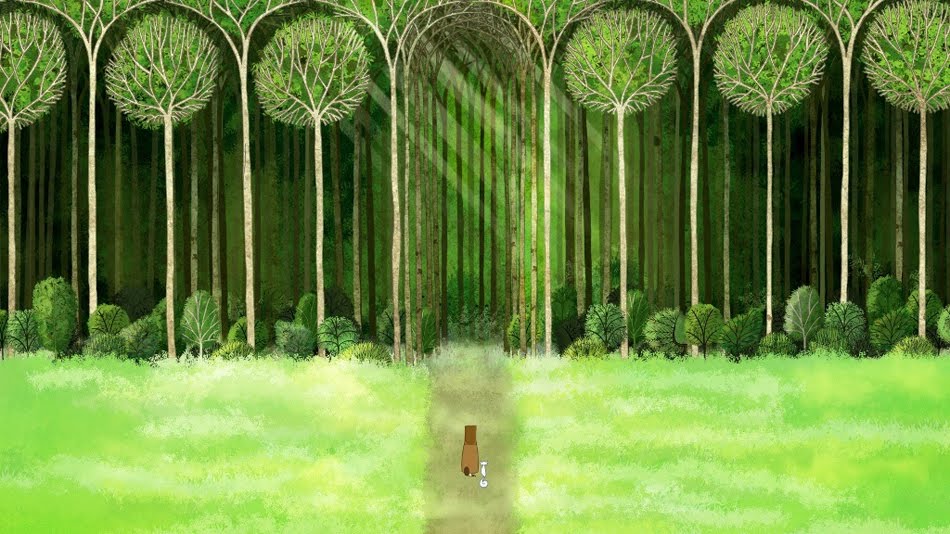

They are set upon by wolves, and narrowly saved by Aisling (sounds like Ashley), a fairy of the woods. In a beautiful sequence, she shows Brendan the woods and all their wonders.


Aidan thinks his drawing is talented enough to be the keystone middle page of the manuscript, and he goes to find a crystal that is needed to see the world in a way to create the beauty of the illustration.

Eventually he is discovered, and his Uncle locks him in the tower until he learns what’s important, and keeps him from the scriptorium. The Vikings attack, Brendan and Aidan escape, and continue work on the book. There’s more, but you get the idea.
That’s quite a lot of it actually.
Kudos for simply the design of the movie. It’s gorgeously designed, fanstasically using the Celtic design and the design of the book to illustrate the story. The directors did not stop themselves from using imagination to tell the story, or to illustrate the feeling of something, rather than the literal illustration of it. The Abbot’s room, for instance, is dark and covered in drawings and architectural plans.

(Beautiful, huh?)
The people themselves are curved, and in groups fit into Romanesque arches.

Celtic knots are used frequently, and are prominent in Brendan’s struggle with the monster he must battle for the crystal. Imagination and concrete reality mix back and forth in a sometimes breathtaking pace, so the viewer is in-between fantasy and reality, impression and observation.
Besides my one main story issue, it’s actually the way the story is told that was somewhat responsible for my lack of emotional involvement. The script is good, and the voice talent is great (though the choice to have a girl with a thick Irish accent whisper at the beginning was weirdly off-putting). What happened for me, though, was that I was so taken with admiring the design and the imagination in telling that the story began to take a backseat. It was a standard boy-who-is-not-listened-to-but-must-save-everyone tale: he has an animal familiar, a guiding older voice who is an artist/sage, and a magical friend who no one else can see but who saves him. It’s all gorgeously done, but I was kept from being completely transported because of the prominence of the design, which felt at times overpowering to the story it was trying to tell. It called itself out a bit.
Looming larger is that though this happens in an Abbey, and among the religious, no one mentions that this “book” Brendan needs to work on and that will save civilization is The Gospels. Nowhere is it mentioned that it’s the story of Christ. Even stranger is that none of the characters, though religious, mention Christ, prayer or devotion. The Abbot is concerned with attack, and the illuminators with “the book”, but seemingly to its own ends - there is no discussion of faith, which seemingly would be at the base of all these actions and beliefs. We are never told why the book is so great, or why eventually it glows when it’s opened and can cause sinners to choke or die. The creators seem to want to glide over that most important fact. And even though I’m not calling for a religious story, it seems to flatten it out when that aspect is missing. It feels like a copout. I guess the big secret of Kells is that this entire community of monks is Christian and trying to save the bible.
I couldn’t help but think that this book they were trying so hard to save became the religion that eventually erased Aisling and her like from Ireland. So the magic in the film, the magic that saves Brendan’s life at least 3 times, is what followers of “the book” did their best to destroy. Brendan even says that the Abbot says she doesn’t exist and the other things are Pagan fantasy. The movie certainly doesn't think so, but doesn't ever deal with it. I guess if they opened that can of worms it would have been a completely different film. But not mentioning what "the book" was and what it’s done seems to be a disservice as well.
Beautiful animation, though, I will say that. Truly a gorgeous design. I'm glad I saw it.
Friday, April 16, 2010
Joni
John Kelly is bringing his Joni Mitchell homage "Paved Paradise" to LA. I saw him several years ago when I lived in NY with a guitar at a bar singing a couple of songs of hers - he's amazing. It's mimicry, but homage, and I think she's appreciative. He played at Fez in NY and she brought him a dulcimer.
I'm excited to see it, but it also reminds me of how much I love her music.
Here's he:
And here's she, singing "Sweet Bird", one of my faves:
This marks the move into "Hejira" at the end of "Hissing of Summer Lawns" to be critical about it, and "Hejira" has some of her best poetry - it's kind of emerged as my favorite of hers probably - if only because of Coyote and Hejira - that song blows me away. Her lyrics are always a knock-out, so here they are for Sweet Bird:
Out on some borderline
Some mark of inbetween
I lay down golden-in time
And woke up vanishing
Sweet bird you are
Briefer than a falling star
All these vain promises on beauty jars
Somewhere with your wings on time
You must be laughing
Behind our eyes
Calendars of our lives
Circled with compromise
Sweet bird of time and change
You must be laughing
Up on your feathers laughing
Golden in time
Cities under the sand
Power, ideals and beauty
Fading in everyone's hand
Give me some time
I feel like I'm losing mine
Out here on this horizon line
With the earth spinning
And the sky forever rushing
No one knows
They can never get that close
Guesses at most
Guesses based on what each set of time and change is touching
Guesses based on what each set of time and change is touching
Guesses based on what each set of time and change is touching
Gorgeous, right? Since we're stream of consciousness, and I have youtube open, here' Hejira, and the lyrics, which lay me flat everytime. With the music, it's just perfection. Never fails.
I'm traveling in some vehicle
I'm sitting in some cafe
A defector from the petty wars
That shell shock love away
There's comfort in melancholy
When there's no need to explain
It's just as natural as the weather
In this moody sky today
In our possessive coupling
So much could not be expressed
So now I'm returning to myself
These things that you and I suppressed
I see something of myself in everyone
Just at this moment of the world
As snow gathers like bolts of lace
Waltzing on a ballroom girl
You know it never has been easy
Whether you do or you do not resign
Whether you travel the breadth of extremities
Or stick to some straighter line
Now here's a man and a woman sitting on a rock
They're either going to thaw out or freeze
Listen
Strains of Benny Goodman
Coming through the snow and the pinewood trees
I'm porous with travel fever
But you know I'm so glad to be on my own
Still somehow the slightest touch of a stranger
Can set up trembling in my bones
I know no one's going to show me everything
We all come and go unknown
Each so deep and superficial
Between the forceps and the stone
Well I looked at the granite markers
Those tribute to finality to eternity
And then I looked at myself here
Chicken scratching for my immortality
In the church they light the candles
And the wax rolls down like tears
There's the hope and the hopelessness
I've witnessed thirty years
We're only particles of change I know I know
Orbiting around the sun
But how can I have that point of view
When I'm always bound and tied to someone
White flags of winter chimneys
Waving truce against the moon
In the mirrors of a modern bank
From the window of a hotel room
I'm traveling in some vehicle
I'm sitting in some cafe
A defector from the petty wars
Until love sucks me back that way
I'm excited to see it, but it also reminds me of how much I love her music.
Here's he:
And here's she, singing "Sweet Bird", one of my faves:
This marks the move into "Hejira" at the end of "Hissing of Summer Lawns" to be critical about it, and "Hejira" has some of her best poetry - it's kind of emerged as my favorite of hers probably - if only because of Coyote and Hejira - that song blows me away. Her lyrics are always a knock-out, so here they are for Sweet Bird:
Out on some borderline
Some mark of inbetween
I lay down golden-in time
And woke up vanishing
Sweet bird you are
Briefer than a falling star
All these vain promises on beauty jars
Somewhere with your wings on time
You must be laughing
Behind our eyes
Calendars of our lives
Circled with compromise
Sweet bird of time and change
You must be laughing
Up on your feathers laughing
Golden in time
Cities under the sand
Power, ideals and beauty
Fading in everyone's hand
Give me some time
I feel like I'm losing mine
Out here on this horizon line
With the earth spinning
And the sky forever rushing
No one knows
They can never get that close
Guesses at most
Guesses based on what each set of time and change is touching
Guesses based on what each set of time and change is touching
Guesses based on what each set of time and change is touching
Gorgeous, right? Since we're stream of consciousness, and I have youtube open, here' Hejira, and the lyrics, which lay me flat everytime. With the music, it's just perfection. Never fails.
I'm traveling in some vehicle
I'm sitting in some cafe
A defector from the petty wars
That shell shock love away
There's comfort in melancholy
When there's no need to explain
It's just as natural as the weather
In this moody sky today
In our possessive coupling
So much could not be expressed
So now I'm returning to myself
These things that you and I suppressed
I see something of myself in everyone
Just at this moment of the world
As snow gathers like bolts of lace
Waltzing on a ballroom girl
You know it never has been easy
Whether you do or you do not resign
Whether you travel the breadth of extremities
Or stick to some straighter line
Now here's a man and a woman sitting on a rock
They're either going to thaw out or freeze
Listen
Strains of Benny Goodman
Coming through the snow and the pinewood trees
I'm porous with travel fever
But you know I'm so glad to be on my own
Still somehow the slightest touch of a stranger
Can set up trembling in my bones
I know no one's going to show me everything
We all come and go unknown
Each so deep and superficial
Between the forceps and the stone
Well I looked at the granite markers
Those tribute to finality to eternity
And then I looked at myself here
Chicken scratching for my immortality
In the church they light the candles
And the wax rolls down like tears
There's the hope and the hopelessness
I've witnessed thirty years
We're only particles of change I know I know
Orbiting around the sun
But how can I have that point of view
When I'm always bound and tied to someone
White flags of winter chimneys
Waving truce against the moon
In the mirrors of a modern bank
From the window of a hotel room
I'm traveling in some vehicle
I'm sitting in some cafe
A defector from the petty wars
Until love sucks me back that way
Tuesday, April 13, 2010
Lists, part ?
Sometimes, when I feel like I haven't had the time to write or haven't been in the frame of mind, I write lists to just get things out of my head - lists of what I would write about or want to. So here's one, hoping I get to:
My trip to New York, including
Next Fall (play)
Sondheim on Sondheim (musical)
God of Carnage (play) and the amazingness of Janet McTeer on stage. Honestly.
Marina Abramovic at MoMA and the self-directedness of performance art
Tim Burton at MoMA
Why Andrew Wyeth's Christina's World is hanging in a hallway (!) at MoMA.
Russian Art history doc that I saw on the plane, that made me think of War and Peace (which is most everything lately)
Recent meditation at Against the Stream in East Hollywood
The experience of doing a show at a small theater in East Hollywood and the insanity of walking into somebody else's club
And...
My trip to New York, including
Next Fall (play)
Sondheim on Sondheim (musical)
God of Carnage (play) and the amazingness of Janet McTeer on stage. Honestly.
Marina Abramovic at MoMA and the self-directedness of performance art
Tim Burton at MoMA
Why Andrew Wyeth's Christina's World is hanging in a hallway (!) at MoMA.

Russian Art history doc that I saw on the plane, that made me think of War and Peace (which is most everything lately)
Recent meditation at Against the Stream in East Hollywood
The experience of doing a show at a small theater in East Hollywood and the insanity of walking into somebody else's club
And...
Saturday, March 27, 2010
Encouragements
A friend pointed this out to me, that it was inspirational to her. It's wonderful. I guess Graham wrote it to DeMille after a piece of hers failed. Brilliant.
A Letter to Agnes DeMille : Martha Graham
There is a vitality, a life force, a quickening
that is translated through you into action,
and because there is only one of you in all time,
this expression is unique.
If you block it,
it will never exist through any other medium
and be lost.
The world will not have it.
It is not your business to determine how good it is;
nor how valuable it is;
nor how it compares with other expressions.
It is your business to keep it yours, clearly and directly,
to keep the channel open.
You do not even have to believe in yourself or your work.
You have to keep open and aware directly
of the urges that motivate you.
Keep the channel open.
No artist is pleased.
There is no satisfaction whatever at any time.
There is only a queer, divine dissatisfaction;
a blessed unrest that keeps us marching
and makes us more alive than the others.
And she mentioned this, too, from Theodore Roosevelt--
It is not the critic who counts: not the man who points out how the strong man stumbles or where the doer of deeds could have done better. The credit belongs to the man who is actually in the arena, whose face is marred by dust and sweat and blood, who strives valiantly, who errs and comes up short again and again, because there is no effort without error or shortcoming, but who knows the great enthusiasms, the great devotions, who spends himself for a worthy cause; who, at the best, knows, in the end, the triumph of high achievement, and who, at the worst, if he fails, at least he fails while daring greatly, so that his place shall never be with those cold and timid souls who knew neither victory nor defeat.
A Letter to Agnes DeMille : Martha Graham
There is a vitality, a life force, a quickening
that is translated through you into action,
and because there is only one of you in all time,
this expression is unique.
If you block it,
it will never exist through any other medium
and be lost.
The world will not have it.
It is not your business to determine how good it is;
nor how valuable it is;
nor how it compares with other expressions.
It is your business to keep it yours, clearly and directly,
to keep the channel open.
You do not even have to believe in yourself or your work.
You have to keep open and aware directly
of the urges that motivate you.
Keep the channel open.
No artist is pleased.
There is no satisfaction whatever at any time.
There is only a queer, divine dissatisfaction;
a blessed unrest that keeps us marching
and makes us more alive than the others.
And she mentioned this, too, from Theodore Roosevelt--
It is not the critic who counts: not the man who points out how the strong man stumbles or where the doer of deeds could have done better. The credit belongs to the man who is actually in the arena, whose face is marred by dust and sweat and blood, who strives valiantly, who errs and comes up short again and again, because there is no effort without error or shortcoming, but who knows the great enthusiasms, the great devotions, who spends himself for a worthy cause; who, at the best, knows, in the end, the triumph of high achievement, and who, at the worst, if he fails, at least he fails while daring greatly, so that his place shall never be with those cold and timid souls who knew neither victory nor defeat.
Thursday, March 25, 2010
Alice in Wonderland
I recently saw Tim Burton’s Disney’s Alice in Wonderland trademark adventure, and I only really have one thought, which is
eh.
I had a reaction similar to my viewing of Nine, though not as vehement: they took something extraordinary and boundary-smashing and made something mundane. This is not saying it’s a successful product, as it clearly is. But I don’t think it’s a successful film.
The book is full of whimsy and nonsense, so you would think it would be a good fit for Burton. The screenwriter, Linda Woolverton (from both “The Lion King” and “Beauty and the Beast”), has created something of a sequel, where Alice is avoiding a marriage proposal and looking for herself in the rabbit hole. We see, in a flashback where the six-year old Alice (who wears lip gloss to bed) complains of a bad dream to her father, that Alice has been dreaming of this world since she was a child. In this version, it’s actually called Underland, and ruled by an evil red queen who is a tyrant, whose sister the White Queen used to rule but has been usurped. All the characters (most from the book – the Rabbit, the Doormouse, Tweedlum and –dee, even the sad addition of a “frumious bandersnatch” – ugh) want the White Queen to be reinstalled, but Alice must save them by slaying the Jabberwocky, and, oh nevermind, I’m too bored to go on. I don’t really care.
And that’s the bottom line. Why not write a new script with characters we’ve never seen before instead of bastardizing two surprising, unexpected great works into one predictable, boring three act girl empowerment story we’ve seen before? It’s could be taken out of “Screenwriting for Dummies”. I see the impulse to make it into a kind of fairy tale with a message, like “Lion King” and “Beauty and the Beast”, but the whole point of Alice, it’s enduring fascination, is that it resists those simple messages. It’s confounding and odd – and as interesting to political theorists, historians, and mathematicians as it is to children. This whole shoehorning into a coherent narrative just makes the whole enterprise feel stifled and mundane. Bonham-Carter is enjoyable to watch (probably the best thing in the film), but Hathaway is wasted (though I'm not sure what anyone could have done with that role). Depp is given a script in which the Hatter is aware of his encroaching or encompassing madness, attempting some sense of tragic realization of his situation, but that ends up as embarrassing and unneeded. Besides laying more on the back of the character than he’s designed to handle, they force him to have a truly cringe-inducing dance moment. Curioser and curiouser. Why?
Oh wait, money….that’s right. I keep forgetting. Well at least someone’s laughing all the way to the bank. Sadly, it’s not the audience. Look, it’s not the worst thing I’ve ever seen, but why not just leave old stuff alone if you can’t respect it for what it is? Or give it a spin that's at least as imaginative and outlandish as the original. This has taken something large, ridiculous, and unruly and tried to make it small, easy, pat and pablum. Not an awful way to spend some time, but not a frabjous day at all.
eh.
I had a reaction similar to my viewing of Nine, though not as vehement: they took something extraordinary and boundary-smashing and made something mundane. This is not saying it’s a successful product, as it clearly is. But I don’t think it’s a successful film.
The book is full of whimsy and nonsense, so you would think it would be a good fit for Burton. The screenwriter, Linda Woolverton (from both “The Lion King” and “Beauty and the Beast”), has created something of a sequel, where Alice is avoiding a marriage proposal and looking for herself in the rabbit hole. We see, in a flashback where the six-year old Alice (who wears lip gloss to bed) complains of a bad dream to her father, that Alice has been dreaming of this world since she was a child. In this version, it’s actually called Underland, and ruled by an evil red queen who is a tyrant, whose sister the White Queen used to rule but has been usurped. All the characters (most from the book – the Rabbit, the Doormouse, Tweedlum and –dee, even the sad addition of a “frumious bandersnatch” – ugh) want the White Queen to be reinstalled, but Alice must save them by slaying the Jabberwocky, and, oh nevermind, I’m too bored to go on. I don’t really care.
And that’s the bottom line. Why not write a new script with characters we’ve never seen before instead of bastardizing two surprising, unexpected great works into one predictable, boring three act girl empowerment story we’ve seen before? It’s could be taken out of “Screenwriting for Dummies”. I see the impulse to make it into a kind of fairy tale with a message, like “Lion King” and “Beauty and the Beast”, but the whole point of Alice, it’s enduring fascination, is that it resists those simple messages. It’s confounding and odd – and as interesting to political theorists, historians, and mathematicians as it is to children. This whole shoehorning into a coherent narrative just makes the whole enterprise feel stifled and mundane. Bonham-Carter is enjoyable to watch (probably the best thing in the film), but Hathaway is wasted (though I'm not sure what anyone could have done with that role). Depp is given a script in which the Hatter is aware of his encroaching or encompassing madness, attempting some sense of tragic realization of his situation, but that ends up as embarrassing and unneeded. Besides laying more on the back of the character than he’s designed to handle, they force him to have a truly cringe-inducing dance moment. Curioser and curiouser. Why?
Oh wait, money….that’s right. I keep forgetting. Well at least someone’s laughing all the way to the bank. Sadly, it’s not the audience. Look, it’s not the worst thing I’ve ever seen, but why not just leave old stuff alone if you can’t respect it for what it is? Or give it a spin that's at least as imaginative and outlandish as the original. This has taken something large, ridiculous, and unruly and tried to make it small, easy, pat and pablum. Not an awful way to spend some time, but not a frabjous day at all.
Tuesday, March 23, 2010
Errors

I was listening to a "Stuff you missed in history class" podcast about the Book of Kells on the way into work this morning, something I was interested in because of the recent animated movie, and so I decided to look at some images. It certainly is beautiful.
And imagine what it might have been with the extra half inch of decoration around the rim that an overzealous bookbinder in the early 19th c trimmed off. Anyhoo, I was reading the wikipedia page, and was struck by this quote:
There are a number of differences between the text and the accepted Gospels. In the genealogy of Jesus, which starts at Luke 3:23, Kells erroneously names an extra ancestor. Elsewhere, Matthew 10:34b should read "I came not to send peace, but a sword," but the manuscript reads gaudium ("joy") where it should read gladium ("sword") and so translates as "I came not [only] to send peace, but joy."
Imagine if that actually was correct, and the quote was really "to send peace, but joy" instead of "a sword". One letter. Probably not true, as I think the gospels were in Greek, not Latin, so this was a Latin mistake, but it's amazing to think how much bloodshed might have been avoided through the ages. I won't get into religion, specifically Christianity, and how passages have been used to enslave or kill others for millenia, but it is wild to think that something like a mistranslation, or a missing letter, could change intent, dogma, rationalization, and history. It boggles the mind.
Wednesday, March 17, 2010
Something Else
I wanted to put up something else besides "bad books", so just letting everyone know I'm 50 chapters into War and Peace and blogging about it. I'm loving it, and reading it slowly, which is really satisfying.
Also, the show I've been assistant directing just got a "Go" in LA Weekly, and looks like it may be extending another 4 weeks. Fingers crossed. It was a good time, and I'm excited for them. Yay, team.
Also, the show I've been assistant directing just got a "Go" in LA Weekly, and looks like it may be extending another 4 weeks. Fingers crossed. It was a good time, and I'm excited for them. Yay, team.
Wednesday, March 10, 2010
Bad Books
I commented on this since I thought it was so ridiculous. I have no issue with people attacking what they see as "the cannon" but this is where academia and arrogance meet to me. LA Times blog has published blurbs from American Book Review's list of bad books which includes, among others, The Great Gatsby and All the Pretty Horses. The criticism is arrogant, and it seems to be to be more about attention grabbing for having a list like this anyway. But here I am posting about it and perpetuating it.
I fell right into that one, didn't I?
I fell right into that one, didn't I?
Wednesday, March 03, 2010
RadioLab
Radiolab, from WNYC, has the subtitle "Curiosity on a Bender". I discovered it from listening to This American Life, and it's really, really wonderful. It takes a general idea and then investigates it. Or, as they put it:
"Radiolab believes your ears are a portal to another world. Where sound illuminates ideas, and the boundaries blur between science, philosophy, and human experience. Big questions are investigated, tinkered with, and encouraged to grow. Bring your curiosity, and we'll feed it with possibility."
So far, I've listened to the "Numbers" podcast, which explores how we learn numbers and the human construction of math. Fascinating.
And now, I'm listening to "Placebo", which explores just that, placebos, and then moves into how we feel and experience pain. And, as one of the hosts said "that's when my mind blew out of my face".
I'm only twenty minutes in, and they've already talked about the effectiveness of placebos in things as difficult to treat as Parkinson's, and then on to how the narrative that we construct around a moment of pain or injury can actually effect how we experience that pain. They talk about a doctor during WWI, who found that soldiers injured had less pain and asked for less morphine than people suffering the same injury at home - precisely because the soldier sees being hit in a positive way - awards, honor, glory, survival, and possibly being sent home - while the person shot in his store, for instance, sees it as loss of income, difficulty, pain...and therefore asks for more morphine. Mind-blowing!
There's so much more in that one, and both of them, to go into, but they're just two of the many. So excellent.
! Really, just !!
"Radiolab believes your ears are a portal to another world. Where sound illuminates ideas, and the boundaries blur between science, philosophy, and human experience. Big questions are investigated, tinkered with, and encouraged to grow. Bring your curiosity, and we'll feed it with possibility."
So far, I've listened to the "Numbers" podcast, which explores how we learn numbers and the human construction of math. Fascinating.
And now, I'm listening to "Placebo", which explores just that, placebos, and then moves into how we feel and experience pain. And, as one of the hosts said "that's when my mind blew out of my face".
I'm only twenty minutes in, and they've already talked about the effectiveness of placebos in things as difficult to treat as Parkinson's, and then on to how the narrative that we construct around a moment of pain or injury can actually effect how we experience that pain. They talk about a doctor during WWI, who found that soldiers injured had less pain and asked for less morphine than people suffering the same injury at home - precisely because the soldier sees being hit in a positive way - awards, honor, glory, survival, and possibly being sent home - while the person shot in his store, for instance, sees it as loss of income, difficulty, pain...and therefore asks for more morphine. Mind-blowing!
There's so much more in that one, and both of them, to go into, but they're just two of the many. So excellent.
! Really, just !!
Sunday, February 28, 2010
Smackdown '09
The Supporting Actress Smackdown for this year's Oscar nominees is up. Yours truly participating. Check it out!
Wednesday, February 24, 2010
Children are Bored on Sunday
I podcast in my car, and it kind of makes up for the loss of subway reading time now that I'm in LA. I have a few faves, and two short story podcasts. This is kind of funny to me, since I don't really love reading short stories. But I really love hearing them read.
If you have an extra 36:44, then take a listen to Jean Stafford's story "Children are Bored on Sunday", which touched me deeply last night when I was listening to it. Hilton Als, the New Yorker theater critic, picked it to discuss on the New Yorker fiction podcast, a monthly series where a writer chooses a story from the magazine's archive and reads it, then discusses the story and the writer. There have been some great ones. I even like the title of this episode, "Invalid Souls", which can play on either pronunciation of invalid, which that word always does. The story was first published in 1948, and I'm surprised how deeply it hit me. You can also read it in the online archive if you subscribe, but it's wonderful listening.
The action is a woman looking at art while avoiding a man she sees, but it's really about her mental state, her drinking, her collapse, and her fragility. I guess since I love the Met, where it's set, and Stafford beautifully catches these moments and the action of her mind drifting from where it should be. Also an incredible picture of mid-century New York intellectuals and what it must have felt like in that demi-monde. There's a great description of never-ending cocktail parties which weren't work, but weren't for fun, either. There was great competition, and conversation about art and ideas, people creating themselves and judging others. It's fascinating. Something about the way she was thinking really got to me. It's a beautiful story. It makes me want to read more of her stuff.
If you have an extra 36:44, then take a listen to Jean Stafford's story "Children are Bored on Sunday", which touched me deeply last night when I was listening to it. Hilton Als, the New Yorker theater critic, picked it to discuss on the New Yorker fiction podcast, a monthly series where a writer chooses a story from the magazine's archive and reads it, then discusses the story and the writer. There have been some great ones. I even like the title of this episode, "Invalid Souls", which can play on either pronunciation of invalid, which that word always does. The story was first published in 1948, and I'm surprised how deeply it hit me. You can also read it in the online archive if you subscribe, but it's wonderful listening.
The action is a woman looking at art while avoiding a man she sees, but it's really about her mental state, her drinking, her collapse, and her fragility. I guess since I love the Met, where it's set, and Stafford beautifully catches these moments and the action of her mind drifting from where it should be. Also an incredible picture of mid-century New York intellectuals and what it must have felt like in that demi-monde. There's a great description of never-ending cocktail parties which weren't work, but weren't for fun, either. There was great competition, and conversation about art and ideas, people creating themselves and judging others. It's fascinating. Something about the way she was thinking really got to me. It's a beautiful story. It makes me want to read more of her stuff.
Tuesday, February 23, 2010
Hats
I've been wanting to write, but I've just been a mite busy. I'm assistant directing a production of Side by Side by Sondheim, which has been a great learning experience. So every workday but Friday I get up, go to work, go to rehearsal, and go home to bed. And there's rehearsal on weekends as well. So, needless to say, a few things have fallen by the wayside, writing being one of them. And cleaning my apartment. And laundry.
But I have not missed a day on my promise to write on War and Peace a chapter a day, though I have to say when I get home at 10:30 I'm not so keen on reading about a war on Napolean and blogging on it. But I am doing it. If I managed during surgery, I'm not about to stop now. And I'm not kvetching - it's enjoyable and a nice wind-down. Certainly a whole 'nother world
Anyhow, now I'm keying up to make a couple of hats. I suggested that we have a couple of large hats for the women to wear while "Beautiful Girls" from Follies is playing. And then I said "I'll make them!". Huh. So I'm skipping from rehearsals this weekend and shopping for hat supplies. I sketched them and the look something like this:

Each of the little squares will be a poster for a Sondheim show - one will have spikes coming from a large glittery white orb. I was thinking the other should be on a pagoda, but now I'm going to see if I can perhaps get a small, portable lamp and do a couple of lamp shades, and then cards will hang on fishing line from the wires. Then just spray it all in translucent glitter. Comedy. There will be pieces of fabric attached to rhinestone (if we can afford it) cuffs that will easily clip on and off the wrist. And, of course, a chin strap.
I do love a great, big hat.
But I have not missed a day on my promise to write on War and Peace a chapter a day, though I have to say when I get home at 10:30 I'm not so keen on reading about a war on Napolean and blogging on it. But I am doing it. If I managed during surgery, I'm not about to stop now. And I'm not kvetching - it's enjoyable and a nice wind-down. Certainly a whole 'nother world
Anyhow, now I'm keying up to make a couple of hats. I suggested that we have a couple of large hats for the women to wear while "Beautiful Girls" from Follies is playing. And then I said "I'll make them!". Huh. So I'm skipping from rehearsals this weekend and shopping for hat supplies. I sketched them and the look something like this:

Each of the little squares will be a poster for a Sondheim show - one will have spikes coming from a large glittery white orb. I was thinking the other should be on a pagoda, but now I'm going to see if I can perhaps get a small, portable lamp and do a couple of lamp shades, and then cards will hang on fishing line from the wires. Then just spray it all in translucent glitter. Comedy. There will be pieces of fabric attached to rhinestone (if we can afford it) cuffs that will easily clip on and off the wrist. And, of course, a chin strap.
I do love a great, big hat.
Tuesday, February 16, 2010
For All You Writers Out There
Elizabeth posted a link to Magpie Tales, who posts a photo to prompt fiction/poems, etc. Each Friday there will be a photo, and each Tuesday you link to this link site with your piece.
Sounds like it could be fun? If it does, then link away!
Sounds like it could be fun? If it does, then link away!
Wednesday, February 10, 2010
Oh!Oh!Oh!


A short paean to the weather. I took a couple of cell phone pictures at work (above), which do nothing to describe the spectacular weather this morning.
LA is stunning after a rain. At least this part of LA - near the hills and the break between valley and valley. Yesterday, as it started to clear, we had three rainbows over the hill behind the lot, and the valley around had specials coming through the clouds. One building would be lit up as if glowing from inside, while next to it would be shadow. It really looked like Hollywood, as if some lighting man might step up and adjust the beam, and the whole picture would shift.
Today, it was unusually brisk as well, so it was clear, and crisp. I love these days. The Hollywood hills are a vibrant green, and the clear air makes the hills and grass look so voluptuous you want to reach out and touch them. Houses are tucked in between the trees, feeling cozy. The light is a bruise of gray with piercing sun, clouds are floating like stretched cotton on a blue, blue watercolor. Everything looks so close up it’s hard to judge distance.
Behind the studio, the hill dazzles, light changing seemingly by the moments as the clouds rush by heading west. There is a little tree that stands at the top, or that's what I think it is. When the hillside burned a couple of years ago, and transformers popped and exploded, the next day a lone tree was still on the top of the hill. It's always looked to me like a pig on a stick, so I call it the pig tree. I guess I could climb up there one day to see it up close, but I'm sure it would transform.
I am a mountain person. I love them. Take your oceans – they’re nice to visit, but from the Green Mountains in Vermont to the Hollywood Hills, I love the plush covered crags and the solidity. And it breaks up the eye. I lived on the plains until I was 12, endless corn and sky that seemed to stop at the end of every field. Mountains let me know how big everything is, but don’t overwhelm me with the impossible infinity of seas. I feel protected by mountains. Always have.
Then you look at the Valley. The mountains in front are desert hills; rocky, craggy, with bits of brush and brown as sand. Behind them, all the peaks are covered in snow, and since the snow level was down to 500 feet the whole mountain is dusted. Majestic. Your face feels just this side of numb, to remind you that you’re human, warm inside, and able to sense the elements with thermometer-like sensitivity. Outside and in your body.
365 degrees and scenes from desert to snow to tropical. It’s on these days I am ecstatic to live here. I used to hate pineapple. I had only ever had canned, so I thought it was nasty - syrupy and strange-tasting. Then my parents went to Hawaii and brought back a fresh pineapple. It was so sweet that I couldn’t believe I had ever mistrusted its gifts. And now, I can eat canned pineapple, since I know the platonic ideal of pineapple. It makes the other stuff more palatable. That’s the way I feel about LA – I know it will be brown and hot, possibly soon, and some days I won’t even see the mountains. But I’ve seen the platonic ideal, I know what’s hiding there. I want to tug on everyone’s sleeve on days like today and say “oh!oh!oh! Look at how beautiful it is! Today! Don’t miss it!”
On days like this it’s hard for me to feel anything but glee. I sit in my car and applaud.
Sunday, February 07, 2010
Surgery, part deux
So, I'm still going to write about it at some point. I'm thinking it might be too early to head back to work tomorrow. I haven't tried to drive. I think I pushed it a bit yesterday. I developed a bruise, which I hear is normal, but it freaked me out. Really not loving abdominal pain, I have to say.
So today I sat home after a friend took me to buy fresh veggies at the farmer's market, took a nap, watched Antiques Roadshow, and six episodes of 30 Rock that I needed to catch up on. The other day I watched Reefer Madness, the musical (okay, not great), and Bernstein's Trouble in Tahiti from the BBC about a difficult marriage.
I have to say, when you're couch-bound, the serious stuff isn't the best to watch. A friend was going to see Fish Tank, which is supposed to be great, but I just didn't think I could stomach it - no pun intended. Tanya picked me up and brought me over ther for chili and tea, and to chat during the second half of the Super Bowl. So glad they live close, and really grateful to have such wonderful friends, cuz I can get a little stir crazy.
But I did read my chapter each day - so I've done 13 so far. Only 352 to go!
So today I sat home after a friend took me to buy fresh veggies at the farmer's market, took a nap, watched Antiques Roadshow, and six episodes of 30 Rock that I needed to catch up on. The other day I watched Reefer Madness, the musical (okay, not great), and Bernstein's Trouble in Tahiti from the BBC about a difficult marriage.
I have to say, when you're couch-bound, the serious stuff isn't the best to watch. A friend was going to see Fish Tank, which is supposed to be great, but I just didn't think I could stomach it - no pun intended. Tanya picked me up and brought me over ther for chili and tea, and to chat during the second half of the Super Bowl. So glad they live close, and really grateful to have such wonderful friends, cuz I can get a little stir crazy.
But I did read my chapter each day - so I've done 13 so far. Only 352 to go!
Thursday, February 04, 2010
Peter and the Wolf
While I was writing today's entry for A Year of War and Peace I thought for an instant that the name of the cat in "Peter and the Wolf" is Sonya. It's not--it's the name of the duck.
But that reminded me of this really special Oscar-winning short of "Peter and the Wolf". If you haven't seen it, do yourself a favor and watch.
a href="
But that reminded me of this really special Oscar-winning short of "Peter and the Wolf". If you haven't seen it, do yourself a favor and watch.
a href="
Tuesday, February 02, 2010
The Immortal Life of Henrietta Lacks
This book looks fascinating - the first paragraph from this Times article:
Fifty years after Henrietta Lacks died of cervical cancer in the “colored” ward at Johns Hopkins Hospital, her daughter finally got a chance to see the legacy she had unknowingly left to science. A researcher in a lab at Hopkins swung open a freezer door and showed the daughter, Deborah Lacks-Pullum, thousands of vials, each holding millions of cells descended from a bit of tissue that doctors had snipped from her mother’s cervix.
The book is about the story, the incredible things that have been done with what turned out to be "immortal" cancer cells, and what rights, if any, the family has to the billions of dollars that have been made from the use of the cells.
It sounds like this is becoming more and more of an issue, and mixing in that with class, race, and the last 50 years in the US, this looks like it could be an amazing book.
Fifty years after Henrietta Lacks died of cervical cancer in the “colored” ward at Johns Hopkins Hospital, her daughter finally got a chance to see the legacy she had unknowingly left to science. A researcher in a lab at Hopkins swung open a freezer door and showed the daughter, Deborah Lacks-Pullum, thousands of vials, each holding millions of cells descended from a bit of tissue that doctors had snipped from her mother’s cervix.
The book is about the story, the incredible things that have been done with what turned out to be "immortal" cancer cells, and what rights, if any, the family has to the billions of dollars that have been made from the use of the cells.
It sounds like this is becoming more and more of an issue, and mixing in that with class, race, and the last 50 years in the US, this looks like it could be an amazing book.
Monday, February 01, 2010
Fondue!

Elizabeth over at a moon, worn as if it had been a shell is giving away a cast iron Rachel Ray fondue pot.
You do not fondue Rachel Ray, she is the celebrity spokesperson.
My favorite fondue memory, aside from the sweet taste of the meat when I was a kid (ah, the 70's), was going to see Aida in the park for one of the Met's free concert. The woman who organized said she'd bring a little something, and brought a fondue pot with fruit and chocolate and a sterno. Wow. So we ate dessert fondue while watching Sharon Sweet in Aida. Pretty great.
So go visit over there and leave a comment to enter. And if you haven't visited, check out a really great blog while you're at it!
Thursday, January 28, 2010
Tarot
I have a little link to a tarot card in my facebook, and here was what it said today:
Not the right time to be alone. Seek out others and be social. More interaction with world and loved ones is needed. Fill your social calendar. Need to get out and have fun. Good time to seek out relationships. Reconnection with others possible now. Find the light inside and share it with the world. Bring your talents into focus and allow others to see them. Stop being so serious and live a little.
Italics mine.
Sometimes, just good to be reminded. It's probably all hoo-ey, especially since it's electronic, but nice to be reminded that being can be light, and worn lightly.
Now, to read more Russians. Hee.
Not the right time to be alone. Seek out others and be social. More interaction with world and loved ones is needed. Fill your social calendar. Need to get out and have fun. Good time to seek out relationships. Reconnection with others possible now. Find the light inside and share it with the world. Bring your talents into focus and allow others to see them. Stop being so serious and live a little.
Italics mine.
Sometimes, just good to be reminded. It's probably all hoo-ey, especially since it's electronic, but nice to be reminded that being can be light, and worn lightly.
Now, to read more Russians. Hee.
Monday, January 25, 2010
Last Station and a new direction
I went to see The Last Station with a friend yesterday and loved it. It's thoughtful, romantic, and grounded with some great performances, mostly, as noted already everywhere, Helen Mirren. It's rare to get such a sweeping romance with an underpinning of great themes and creeping revolution. Christopher Plummer was wonderful as well, and so too was Paul Giamatti and James McEvoy (who is basically adorable - there, I've said it - shallow, I know, but true). I don't know who Kerry Condon is, but great job as well. And I am a sucker for birch trees and beautiful forest scenes. I really was tense at one point about what was going to happen, so much so my palms were sweating. Avatar, I was a little nervous. This one, waiting to know if Tolstoy was really going to sign away the rights to his life's work and go against the wishes of his wife - pulse quickening.
Anyhow, aside from the majority of Anna Karenina, which I read in high school and then wrote a paper on (I had a habit of picking books and then writing on characters who die half-way through, or themes I could pick up and extrapolate - what a slacker), I haven't read a lot of Tolstoy. In September, I met a man at a retreat who was a Sufi and also taught Tolstoy. He loves War and Peace, and said teaching it actually makes him cry. That's quite a recommendation. And I've heard about the beauty and majesty of this book before.
So seeing The Last Station, I thought maybe I could read it. Then I had the idea of reading it and blogging about it at the same time. Then I looked at a version online and saw that it has many chapters. In fact, after looking at an online version, it's 15 books and 2 epilogues (although the wikipedia entry says it's 4 books and two epilogues), divided into 365 chapters. 365. One for each day of the year. Accident? I think not.
I looked around, and found several blogs where people were planning on doing this--
Reading war and peace, where a woman blogs about a trip around the world with her husband and two young sons. It was started in 2003, ended in 2005, and all I could find about the book was one of the last entries "Someone asked me just recently if it was worth the effort and I would certainly say it was. My only criticism would be that there were too many battles in it." So, not really a simultaneous blog kind of thing.
Then there is war and peace project, which is a good name, but sadly an anemic blog. Only three entries, the last one being in 2008, about chapters 1 -3.
Then there's the simple war and peace, by the promisingly named blogger "Anastasia" which will be about her feelings, tortured or otherwise (her words), started in 2000. There are no entries.
I also stumbled across reading Middlemarch, which is something I've always wanted to do as well. It looks like an online book group, and they read War and Peace as well. Interesting idea, online bookgroup, but reading is so solitary already. I guess it's a step in connecting about it, and views from people all over. I still need to read Middlemarch. And the rest of Magic Mountain, which I loved, and then got mired down during one of Settembrini's speeches about the meaning of life. In 1999.
So I entertained a bunch of names, including "war and peace 365", which sounds too much like a hip bistro, or "reading war and peace 365", which is clumsy, and I finally settled on "a year of war and peace", but sadly, it's registered, but doesn't show as a blog (!). So, the blog will be titled "A Year of War and Peace" even though it's really http://yearofwarandpeace.blogspot.com/. I'm looking for the Richard Pevear and Larissa Volokhonsky translation since everyone flipped for their "Brothers Karamazov", speaking of other books I've started on not finished.
Before you get all finger-pointy, it's long. Really long. And remember it was serialized in the 19th century. And there was no television. And long nights. Especially in Russia.
So, I'm not sure when I'll officially start (I have surgery on the 4th of February, so I may start after that), but check back. I'll post over here once I do, for the ones of you reading here. I suppose, in solidarity with Tolstoy's views, I can look upon this as a spiritual practice. At least a practice that I will do every day. Didn't work with meditation, but hey, one can dream.
And for all you that read the blog, maybe you'll be able to feel like you've read it, or be interested in picking it up yourself. More conversation is more good.
Onward!
Or, Вперед, as the Russian translation engine on the web tells me.
Now, to buy the book....
Anyhow, aside from the majority of Anna Karenina, which I read in high school and then wrote a paper on (I had a habit of picking books and then writing on characters who die half-way through, or themes I could pick up and extrapolate - what a slacker), I haven't read a lot of Tolstoy. In September, I met a man at a retreat who was a Sufi and also taught Tolstoy. He loves War and Peace, and said teaching it actually makes him cry. That's quite a recommendation. And I've heard about the beauty and majesty of this book before.
So seeing The Last Station, I thought maybe I could read it. Then I had the idea of reading it and blogging about it at the same time. Then I looked at a version online and saw that it has many chapters. In fact, after looking at an online version, it's 15 books and 2 epilogues (although the wikipedia entry says it's 4 books and two epilogues), divided into 365 chapters. 365. One for each day of the year. Accident? I think not.
I looked around, and found several blogs where people were planning on doing this--
Reading war and peace, where a woman blogs about a trip around the world with her husband and two young sons. It was started in 2003, ended in 2005, and all I could find about the book was one of the last entries "Someone asked me just recently if it was worth the effort and I would certainly say it was. My only criticism would be that there were too many battles in it." So, not really a simultaneous blog kind of thing.
Then there is war and peace project, which is a good name, but sadly an anemic blog. Only three entries, the last one being in 2008, about chapters 1 -3.
Then there's the simple war and peace, by the promisingly named blogger "Anastasia" which will be about her feelings, tortured or otherwise (her words), started in 2000. There are no entries.
I also stumbled across reading Middlemarch, which is something I've always wanted to do as well. It looks like an online book group, and they read War and Peace as well. Interesting idea, online bookgroup, but reading is so solitary already. I guess it's a step in connecting about it, and views from people all over. I still need to read Middlemarch. And the rest of Magic Mountain, which I loved, and then got mired down during one of Settembrini's speeches about the meaning of life. In 1999.
So I entertained a bunch of names, including "war and peace 365", which sounds too much like a hip bistro, or "reading war and peace 365", which is clumsy, and I finally settled on "a year of war and peace", but sadly, it's registered, but doesn't show as a blog (!). So, the blog will be titled "A Year of War and Peace" even though it's really http://yearofwarandpeace.blogspot.com/. I'm looking for the Richard Pevear and Larissa Volokhonsky translation since everyone flipped for their "Brothers Karamazov", speaking of other books I've started on not finished.
Before you get all finger-pointy, it's long. Really long. And remember it was serialized in the 19th century. And there was no television. And long nights. Especially in Russia.
So, I'm not sure when I'll officially start (I have surgery on the 4th of February, so I may start after that), but check back. I'll post over here once I do, for the ones of you reading here. I suppose, in solidarity with Tolstoy's views, I can look upon this as a spiritual practice. At least a practice that I will do every day. Didn't work with meditation, but hey, one can dream.
And for all you that read the blog, maybe you'll be able to feel like you've read it, or be interested in picking it up yourself. More conversation is more good.
Onward!
Or, Вперед, as the Russian translation engine on the web tells me.
Now, to buy the book....
Sunday, January 24, 2010
Famous Blue Raincoat
This song just came up when I was resynching my iTunes. My late friend Lisa used to listen to Jennifer Warnes album "Famous Blue Raincoat" over and over. Right before we moved in together, in 1988, she said she had it on the turntable for 6 months straight.
Remember turntables?
Everyone thought we looked like brother and sister - similar coloring. We lost touch, but talked every few years, and then she moved back to Albuquerque and passed away from a freak illness. I'm blessed to have known her.
I can't hear this song, or any of Jennifer Warnes versions of Leonard Cohen (so almost any of his songs), without thinking of her.
Not maudlin feeling, but just remembering. I have no idea what the song's about, which is why it's so intriguing. It's the taste of story on your tongue, but you can't fully name it. It's probably about Dylan or something, since it seems like all the songs of this period are about him or Mick Jagger. Whatever it's about, it's a beautiful song. And I'm posting in memory of a beautiful woman. Very missed.
Remember turntables?
Everyone thought we looked like brother and sister - similar coloring. We lost touch, but talked every few years, and then she moved back to Albuquerque and passed away from a freak illness. I'm blessed to have known her.
I can't hear this song, or any of Jennifer Warnes versions of Leonard Cohen (so almost any of his songs), without thinking of her.
Not maudlin feeling, but just remembering. I have no idea what the song's about, which is why it's so intriguing. It's the taste of story on your tongue, but you can't fully name it. It's probably about Dylan or something, since it seems like all the songs of this period are about him or Mick Jagger. Whatever it's about, it's a beautiful song. And I'm posting in memory of a beautiful woman. Very missed.
Subscribe to:
Posts (Atom)